
Table of Contents
What Are Linerless Labels?
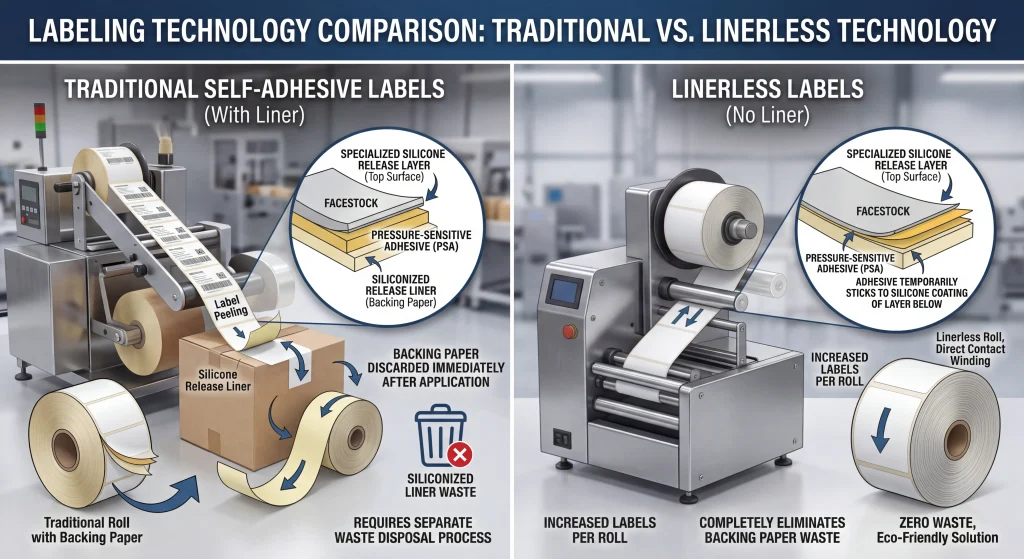
Traditional self-adhesive labels are built on a siliconized release liner (backing paper) that is discarded immediately after the label is applied. In contrast, linerless labels completely eliminate this backing paper.
Instead of a liner, the facestock of a linerless label is coated with a specialized silicone release layer on the top surface. The pressure-sensitive adhesive (PSA) is applied to the bottom. When wound into a roll, the adhesive sticks temporarily to the silicone coating of the layer below it—much like a roll of standard adhesive tape.
Understanding adhesives is only part of the equation. Learn how Facestocks and Liners work together in our comprehensive breakdown: The Ultimate Guide to Self-Adhesive Packaging Materials: Adhesives, Liners & Facestocks ➔
The Environmental and Operational ROI
Switching to linerless technology is not just an eco-friendly PR move; it brings measurable cost savings and operational efficiencies to industrial packaging lines. This directly aligns with global Circular Economy principles.
- Zero Liner Waste: Traditional backing paper accounts for up to 40% of a label roll’s weight and volume. Eliminating it instantly removes waste disposal and landfill costs.
- More Labels Per Roll: Without the thickness of the liner, you get up to 60% more labels on a roll of the same diameter.
- Reduced Downtime: More labels per roll means fewer roll changeovers for operators, increasing machine uptime.
- Lower Shipping Costs: Less weight and smaller volumetric profiles result in reduced freight and storage expenses.
Linerless vs. Traditional Pressure-Sensitive Labels
While linerless is the future for many sectors (like logistics, weigh-scale printing, and fast-food labeling), it’s important to understand the engineering trade-offs compared to traditional setups.
| Feature | Traditional PSA Labels | Linerless Labels |
|---|---|---|
| Waste Generated | High (Release liner discarded) | Zero (100% material utilized) |
| Labels per Roll | Standard | Up to 60% more |
| Shape & Cutting | Any die-cut shape possible | Mostly restricted to squares/rectangles (cut by guillotine) |
| Application Speed | Ultra-high speeds possible | Slightly slower (depends on the cutter mechanism) |
Equipment Upgrades: Are You Ready for Linerless?
The primary barrier to adopting linerless labels is hardware. You cannot run linerless rolls on standard label applicators. Because the material relies on a continuous feed without a carrier web, you need specialized linerless thermal printers and applicators equipped with non-stick platen rollers and automatic guillotine cutters.
According to recent sustainability reports by FINAT (The European association for the self-adhesive label industry), the adoption of linerless technology is accelerating by over 15% annually in the logistics and retail sectors as brands push for zero-waste packaging.
Expert Conclusion & Specification
Whether you are transitioning your thermal-transfer logistics labels to a linerless system, or seeking traditional acrylic and rubber adhesives for extreme environments, Jumelage engineers are here to assist.
Linerless technology requires precision silicone coating and aggressive hot-melt adhesives. Let us analyze your print hardware and environmental constraints to recommend the perfect sustainable formulation.
Overcoming Linerless Adhesion Challenges
While the benefits of linerless labels are undeniable, engineering a functional linerless roll presents unique chemical and mechanical challenges. Because the adhesive rests directly on the facestock of the layer below it, the balance of the silicone release coating is absolutely critical to the success of the product.
If the silicone release layer is too heavy, the pressure-sensitive adhesive may not bond properly to the final container surface upon application. Conversely, if the release coating is too light, the roll will “block” or fuse together in storage, causing catastrophic printer jams, adhesive oozing, and tearing during the dispensing process.
Furthermore, without a backing paper to provide structural rigidity, linerless materials are inherently more prone to stretching and deformation. High-quality manufacturing requires specialized web tension control during the coating process. This ensures the material feeds smoothly through thermal printers and automated guillotine cutters without wrinkling, maintaining pristine print registration for barcodes and variable data.
Ready to upgrade your packaging line?
liminate waste and cut downtime. Request testing samples of our latest linerless formulations and see the ROI for your facility.
