
Table of Contents
In the high-stakes world of industrial logistics and pharmaceutical supply chains, Security Barcode Labels serve as the frontline defense against counterfeiting and unauthorized tampering. Protecting high-value assets is no longer just about tracking; it is about ensuring the physical integrity of the packaging. In this 1,500-word engineering deep-dive, we explore the material science, adhesive performance, and implementation strategies required to deploy a bulletproof security labeling system.
To master the science behind the bond, explore how high-tack acrylics behave on low surface energy substrates in our comprehensive breakdown: The Ultimate Guide to Self-Adhesive Packaging Materials: Adhesives, Liners & Facestocks ➔
The Anatomy of Modern Security Barcode Labels
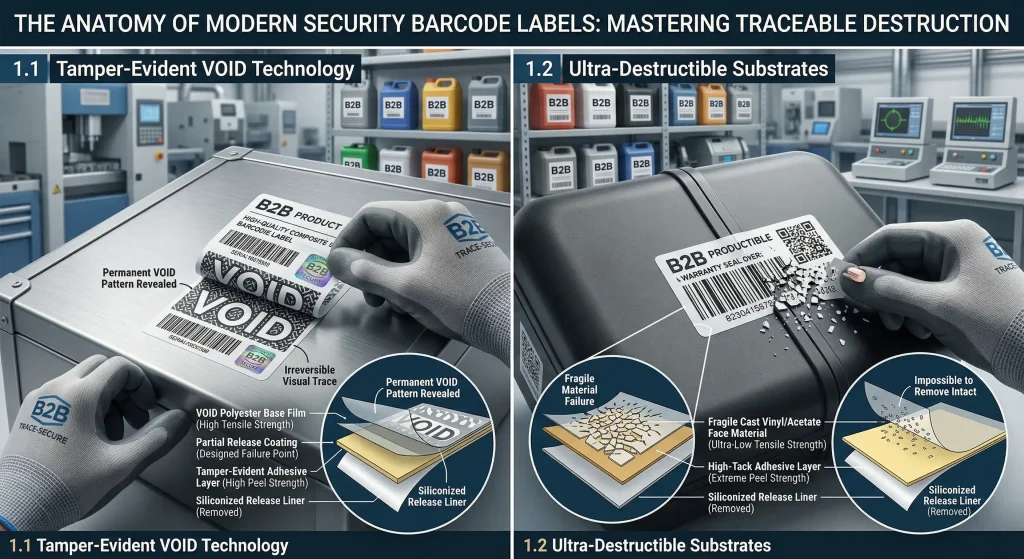
At its core, a Security Barcode Label is a sophisticated multi-layer laminate designed to fail intentionally when tampered with. Unlike standard Self-Adhesive Packaging Materials, which prioritize bond strength and clarity, security labels are engineered for “traceable destruction.”
1.1 Tamper-Evident VOID Technology
The most common form of security labeling utilizes a “VOID” polyester base. This material is engineered with a partial release coating between the film and the adhesive. When the label is peeled, the coating splits, leaving a permanent “VOID” or checkerboard pattern on the substrate while simultaneously appearing on the label face. This provides immediate, irreversible visual evidence of tampering.
1.2 Ultra-Destructible Substrates
Used extensively in electronics for warranty seals, destructible Security Barcode Labels are made from a highly fragile cast vinyl or acetate. The tensile strength of the face material is significantly lower than the bond strength of the adhesive. Consequently, any attempt to remove the label results in the material breaking into tiny, non-removable fragments.
Advanced Adhesives: The Silent Guardian of Security
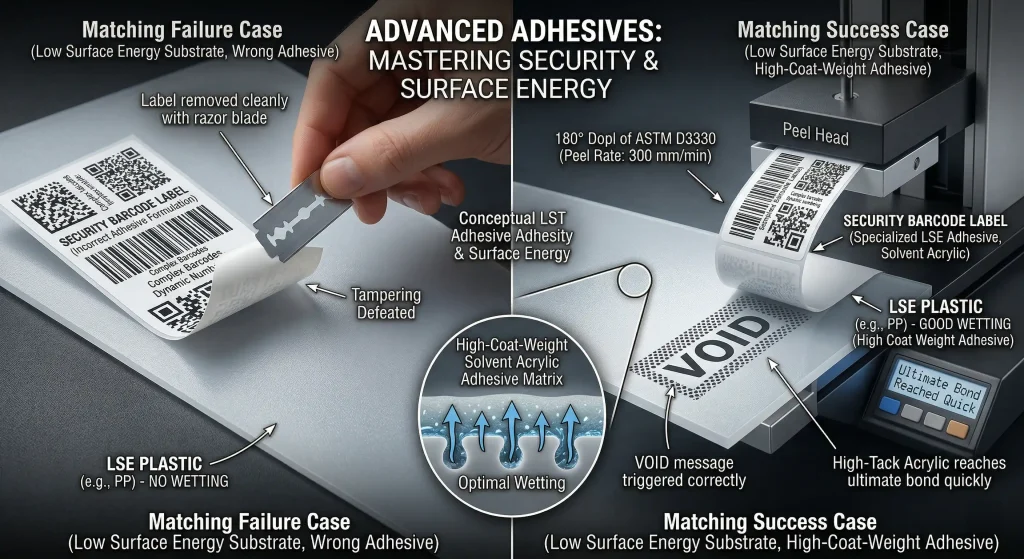
A security label is only as effective as the adhesive that anchors it. For these labels to function, the bond to the substrate must exceed the internal cohesive strength of the security feature. This requires a deep understanding of Pressure Sensitive Adhesive formulations.
2.1 High-Tack Acrylic Formulations
Most Security Barcode Labels utilize high-performance solvent acrylics. These adhesives provide excellent resistance to environmental stressors such as UV exposure, temperature fluctuations (-40°C to +150°C), and chemical solvents. According to ASTM D3330 (Standard Test Method for Peel Adhesion), security adhesives must reach their maximum “ultimate bond” quickly—often within minutes—to prevent early-stage tampering.
2.2 The Challenge of Surface Energy
One of the most frequent causes of security failure is a mismatch between the adhesive and the substrate’s surface energy. For low surface energy (LSE) plastics like Polypropylene (PP), a specialized high-coat-weight adhesive is required to ensure the “VOID” message triggers correctly. Without proper wetting, a security label might be cleanly removed with a razor blade, defeating its entire purpose.
Comparative Analysis: Security Label Technologies
To help procurement managers select the right Security Barcode Labels, the following table compares the three dominant technologies in the industrial market.
| Feature | VOID Polyester | Destructible Vinyl | Pattern Release (Checkered) |
|---|---|---|---|
| Primary Use | Shipping & Warranty | Electronics/Seals | Retail/High-Value Goods |
| Tamper Evidence | High (Visual Pattern) | Extreme (Fragmentation) | Moderate (Ghost Image) |
| Temperature Range | -40°C to +125°C | -20°C to +100°C | -30°C to +110°C |
| Durability | High (Tear Resistant) | Low (Fragile by Design) | Moderate |
| Barcode Clarity | Excellent (Thermal/UV) | Good | Excellent |
Engineering Standards and Compliance (E-E-A-T)
When deploying Security Barcode Labels globally, adherence to international standards is non-negotiable. Leading manufacturers reference the ISO 17712 standards for mechanical seals and the FINAT (European Association for the Self-Adhesive Labeling Industry) test methods for peel and shear resistance.
For pharmaceutical applications, security labels must often meet FDA 21 CFR Part 211 requirements for tamper-evident packaging. This involves rigorous testing of the “label-to-carton” bond under various humidity levels to ensure the security feature does not “self-trigger” during refrigerated transport.
Industrial Application Scenarios
In the electronics sector, Security Barcode Labels are utilized to protect internal components and validate warranty claims. A common “best practice” involves using a silver VOID polyester label over a chassis screw. If the consumer attempts to open the device, the silver residue remains on the screw head, providing the manufacturer with undeniable proof of a voided warranty.
With the rise of high-value biologics, the cold chain requires labels that can maintain security at -80°C (cryogenic storage). Specialized Security Barcode Labels are now engineered with “Cryo-adhesives” that remain flexible at ultra-low temperatures, ensuring that the tamper-evident feature remains active even in deep-freeze environments.
How to Implement a Security Labeling System: A Troubleshooting Guide
Even the best Security Barcode Labels can fail if the application environment is not controlled. Here is an engineering checklist to ensure 100% reliability:
- Substrate Cleaning: Ensure the surface is free of oils and silicone mold-release agents. Even a microscopic layer of contamination can prevent the adhesive from forming a permanent bond.
- Dwell Time: Most security adhesives require a minimum of 24 hours to reach full bond strength. Testing the tamper-evidence feature 5 seconds after application will yield inaccurate results.
- Pressure Application: As the name “Pressure Sensitive” implies, a firm application (ideally via a weighted roller or high-pressure applicator arm) is required to drive the adhesive into the micro-valleys of the substrate.
- Environmental Shielding: If the label will be exposed to outdoor elements, specify a UV-resistant over-laminate to prevent the barcode from fading or the destructible material from becoming overly brittle.
Furthermore, without a backing paper to provide structural rigidity, linerless materials are inherently more prone to stretching and deformation. High-quality manufacturing requires specialized web tension control during the coating process. This ensures the material feeds smoothly through thermal printers and automated guillotine cutters without wrinkling, maintaining pristine print registration for barcodes and variable data.
The Future of Smart Security Labels
The next generation of Security Barcode Labels is moving beyond physical destruction. We are seeing the integration of Encrypted QR Codes and NFC/RFID Tags directly into the security laminate. These “Smart Security Labels” allow for dual-factor authentication:
- Physical: The VOID or destructible feature.
- Digital: A unique, encrypted digital twin stored on the blockchain, accessible via a smartphone scan.
By combining these technologies, manufacturers can achieve a level of brand protection that was previously impossible.
Conclusion: Choosing the Right Security Partner
Selecting the optimal Security Barcode Labels is a balance of material science, adhesive engineering, and environmental awareness. For industrial directors, the goal is to choose a material that is robust enough for the rigors of shipping but sensitive enough to reveal the slightest hint of unauthorized access.
Whether you are protecting high-end consumer electronics or life-saving pharmaceuticals, understanding the technical nuances of your label construction is the ultimate security measure.
Secure Your Supply Chain Today
Jumelage provides expert-grade Security Barcode Labels tested to FINAT and FDA standards. Ensure your brand’s integrity with our lab-verified tamper-evident jumbo rolls.
