
Table of Contents
What Does Self-Adhesive Mean?
This might sound simple, but the engineering required to make a label stick reliably to a corrugated box in a humid warehouse is fundamentally different from making one adhere to a glass pharmaceutical vial stored at -20°C. The adhesive chemistry, the facestock, and the release liner all have to work together as a system. We explore each of these layers in detail in our PSA Engineering Guide.
Chemical compatibility between the facestock coating and the adhesive determines the long-term archival quality of a label. Explore how we match TPF paper with the right adhesives in our engineering breakdown: The Ultimate Guide to Self-Adhesive Packaging Materials: Adhesives, Liners & Facestocks ➔
What Is Self-Adhesive Also Known As?
Self-adhesive goes by several names depending on who you ask. Pressure-sensitive, peel-and-stick, and self-stick all describe the same core technology. In European technical standards, you will often see it referred to as “self-adhesive laminate” or simply “PSA material.”
The variety of names can cause confusion during international procurement. A buyer in Germany might request “Haftetiketten” while a logistics manager in São Paulo searches for “etiquetas autoadesivas”—but the underlying product is identical. At Jumelage, we standardize our technical documentation around the term Pressure-Sensitive Adhesive (PSA) to eliminate ambiguity across our 50+ export markets.
What Is Self-Adhesive Made Of?
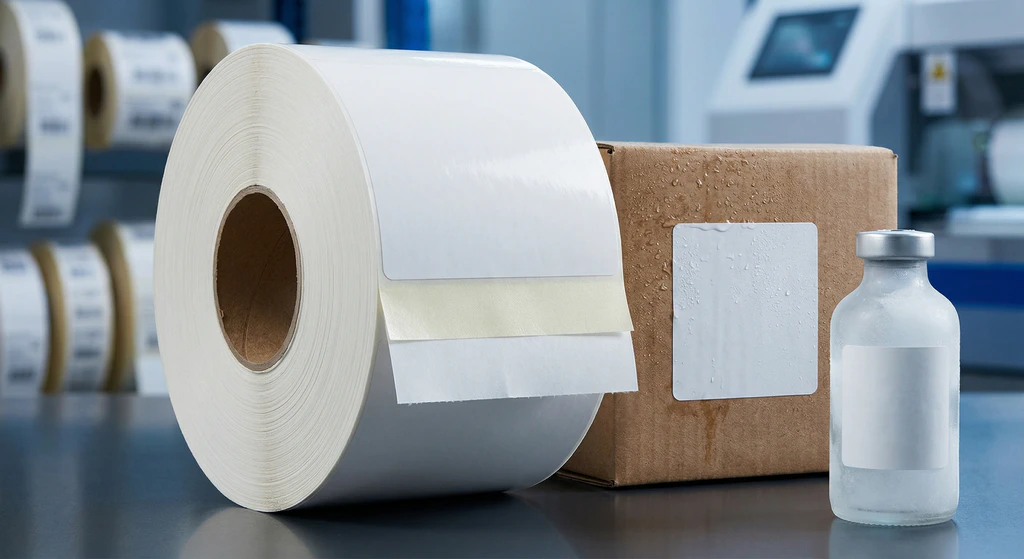
Answering what does self-adhesive mean requires looking at the 3-layer sandwich construction.This is where most buyers underestimate the complexity. A self-adhesive label is not a single material—it is a three-layer engineered composite:
Layer 1: Facestock (The Printable Surface) This is the material you actually see—the printed surface of the label. Common facestocks include:
- White PET Film — Durable, tear-resistant, ideal for chemical drums and outdoor applications.
- BOPP (Biaxially Oriented Polypropylene) — Flexible, moisture-resistant, the workhorse of food and beverage labeling.
- Thermal Paper — Heat-activated printing surface used in logistics labels, POS receipts, and weighing scales.
Layer 2: The Adhesive The invisible but critical middle layer. This is typically an acrylic-based or rubber-based PSA. The choice depends entirely on the end application:
- Acrylic adhesives offer long-term UV resistance and chemical stability.
- Rubber-based adhesives provide aggressive initial tack on rough or cold surfaces.
For a deep technical comparison of adhesive formulations, our Pressure-Sensitive Adhesive Guide covers viscosity, shear strength, and peel adhesion testing in detail.
Layer 3: Release Liner (The Backing) The silicone-coated paper or film that protects the adhesive until the moment of application. Liner engineering is often overlooked, but a poorly designed liner causes die-cutting failures and label jams on high-speed applicators. Jumelage manufactures both Glassine and PET release liners in-house, giving us full control over release force consistency.
What Are Three Types of Adhesive?
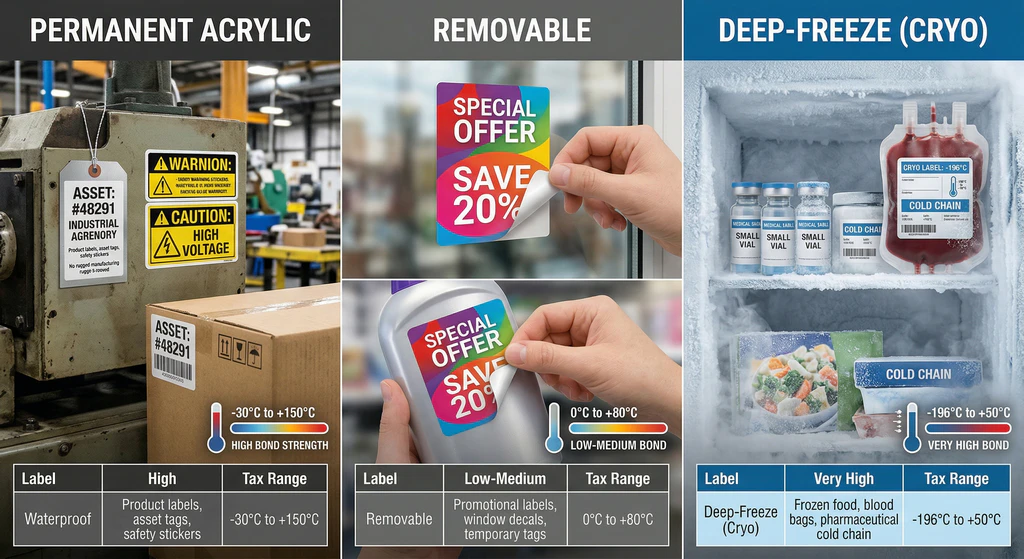
In industrial labeling, the three primary adhesive categories are:
| Adhesive Type | Bond Strength | Best Application | Temperature Range |
|---|---|---|---|
| Permanent Acrylic | High | Product labels, asset tags, safety stickers | -30°C to +150°C |
| Removable | Low-Medium | Promotional labels, window decals, temporary tags | 0°C to +80°C |
| Deep-Freeze (Cryo) | Very High | Frozen food, blood bags, pharmaceutical cold chain | -196°C to +50°C |
The table above highlights why what does self-adhesive mean varies by application.
Each type is engineered for a specific failure mode. A permanent acrylic adhesive is designed to never come off. A removable adhesive is designed to release cleanly without residue. And a deep-freeze adhesive must bond aggressively to surfaces already at sub-zero temperatures—a challenge that standard adhesives simply cannot handle.
For buyers sourcing materials for cold chain and medical applications, choosing the wrong adhesive type is the most common and most costly mistake in the supply chain.
What Is Another Word for Self-Adhesive?
Beyond “pressure-sensitive” and “peel-and-stick,” several industry-specific synonyms exist:
- Labelstock — Refers specifically to self-adhesive material sold in jumbo rolls before die-cutting.
- PSA Laminate — The technical term used in ISO and FINAT testing standards.
- Sticker material — Informal, but widely used in consumer markets.
- Self-cling — Sometimes confused with self-adhesive, but technically refers to static-cling films that use no adhesive at all.
Understanding these terms matters when writing procurement specifications. If your RFQ says “sticker material” when you actually need “PSA laminate with permanent acrylic adhesive on 50μm white PET facestock,” you will receive wildly inconsistent quotes from different suppliers.
Why Material Composition Matters for Global Sourcing
The self-adhesive industry is consolidating around manufacturers who control the full stack—facestock coating, adhesive formulation, and liner production. Sourcing each layer from different suppliers introduces compatibility risks that only show up during high-speed converting or months after application.
At Jumelage, our 35,000㎡ GMP-certified production base integrates all three layers under one roof. As a China-France joint venture, we combine European material science standards with large-scale Asian manufacturing efficiency, providing full Technical Data Sheets (TDS) and SGS/Intertek laboratory reports for every batch of jumbo rolls.
Whether you are a label converter processing 200,000 square meters per month or a pharmaceutical company requiring FDA-compliant cold chain materials, understanding what self-adhesive actually means—down to the molecular level—is the first step toward building a reliable supply chain.
Ready to Source Premium Self-Adhesive Materials?
By now, the definition of what does self-adhesive mean should be clear to any professional buyer.
