
Table of Contents
In industrial manufacturing and global logistics, specifying the correct bonding agent is a high-stakes engineering decision. When evaluating production lines, the debate of self-adhesive vs. adhesive formats often dictates the speed of assembly, the cost of specialized applicators, and the long-term durability of the brand packaging.
Understanding the technical nuances of self-adhesive vs. adhesive is critical for 2026 compliance. As regulations around volatile organic compounds (VOCs) tighten across Europe and North America, buyers are forced to rethink how their labels and components stick. This guide strips away the marketing jargon to break down the chemistry, performance metrics, and operational differences between pressure-sensitive laminates and traditional liquid or hot-melt adhesives.
Self-Adhesive vs. Adhesive: What Is the True Difference?
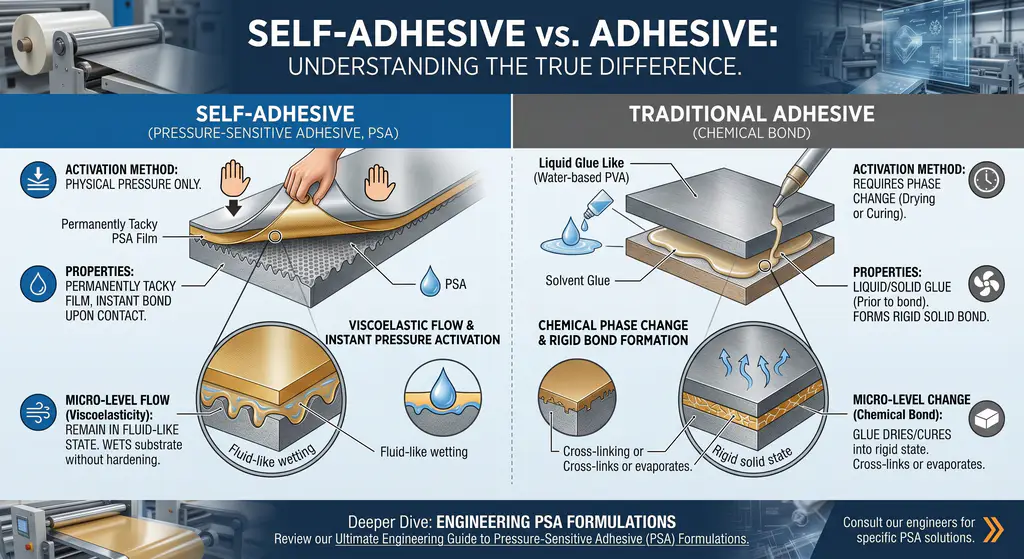
When analyzing self-adhesive vs. adhesive, the main distinction is the activation method. “Self-adhesive” (or Pressure-Sensitive Adhesive, PSA) is a permanently tacky film that bonds instantly upon physical pressure without water, heat, or solvents. “Adhesive” is a broad category of liquid or solid glues requiring a chemical phase change (drying or curing) to bond.
The fundamental science separating the two is viscoelasticity. A self-adhesive material remains in a fluid-like state, wetting the microscopic valleys of a substrate without ever fully hardening. A traditional adhesive, like a water-based PVA or solvent glue, evaporates or chemically cross-links until it becomes a rigid solid. For a deeper dive into how PSA structures are engineered, you can review our Ultimate Engineering Guide to Pressure-Sensitive Adhesive (PSA) Formulations.
Chemical compatibility between the facestock coating and the adhesive determines the long-term archival quality of a label. Explore how we match TPF paper with the right adhesives in our engineering breakdown: The Ultimate Guide to Self-Adhesive Packaging Materials: Adhesives, Liners & Facestocks ➔
Which is Stronger, Glue or Adhesive?
A common question in the self-adhesive vs. adhesive discussion is shear strength. Technically, “glue” is a natural subset of “adhesive” made from animal or plant byproducts. Synthetic adhesives (epoxies, polyurethanes) are significantly stronger than traditional glue. However, structural adhesives offer the highest tensile strength but lack the flexibility of pressure-sensitive self-adhesives.
For packaging and labeling, pure structural strength is rarely the goal. If a label’s adhesive is stronger than the cardboard box (the substrate), attempting to remove it will cause fiber tear. In B2B label procurement, we measure performance through “Peel Adhesion” and “Tack,” tested according to strict ISO 29862:2018 Standards. If you need to understand the basic terminology before proceeding, read our foundational article: What Does Self-Adhesive Mean?.
What's the Strongest Adhesive?
In the ongoing comparison of self-adhesive vs. adhesive, two-part epoxy resins are the absolute strongest structural adhesives available, capable of holding thousands of pounds per square inch. However, within the self-adhesive (PSA) category, cross-linked solvent acrylics are the strongest, offering extreme resistance to chemicals, UV degradation, and extreme temperature fluctuations.
Choosing the “strongest” is not always optimal. If a logistics manager uses a high-shear permanent acrylic on a reusable plastic tote, the label will be impossible to remove cleanly, causing severe maintenance issues. We have detailed the chemical interactions involved in removal in our guide: Is Self-Adhesive Easy to Remove?. For applications requiring the strongest PSA bonds—such as cryogenic storage down to -196°C—engineers must specify specialized deep-freeze formulas, as explored in our Cold Chain & Medical Label Guide.
Which Tape is Self-Adhesive But Not Sticky?
Another layer to the self-adhesive vs. adhesive topic involves tapes that feel dry to the touch. Self-amalgamating tape (or silicone fusing tape) and static cling films are self-adhesive but not sticky. They bond by fusing to themselves via polymerization or by creating a micro-vacuum on smooth surfaces like glass.
While static clings have no chemical tackifier, they belong to a niche market. They are completely distinct from traditional pressure-sensitive laminates, resolving the common buyer confusion addressed in our post: Does Self-Adhesive Mean Sticker?. True non-sticky innovations in the B2B sector focus on removing the silicone liner waste entirely, a technology we break down in our Linerless Labels 2026 Engineering Guide.
How Long Do Self-Adhesives Last?
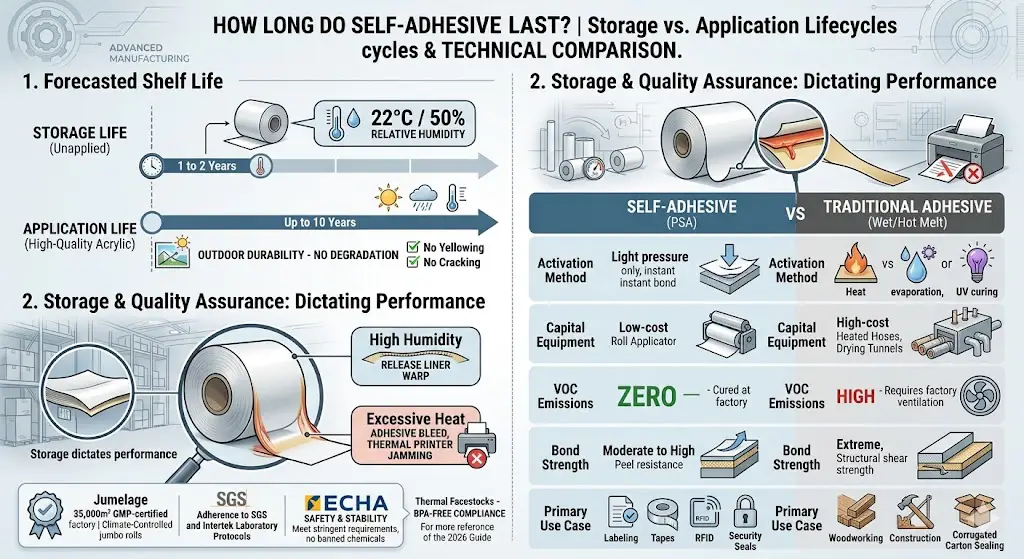
When forecasting shelf life for self-adhesive vs. adhesive applications, B2B buyers should expect a premium self-adhesive material to last 1 to 2 years in storage (unapplied) at 22°C and 50% relative humidity. Once applied to a compatible surface, a high-quality acrylic self-adhesive can last up to 10 years outdoors without degrading.
Storage conditions strictly dictate performance. High humidity can cause the release liner to warp, while excessive heat can cause the adhesive to “bleed” out from the edges of the roll, jamming thermal printers. At Jumelage’s 35,000㎡ GMP-certified factory, all jumbo rolls are climate-controlled prior to shipping. We strictly adhere to SGS and Intertek laboratory protocols to guarantee the archival life of our PSA laminates. Furthermore, our coatings meet the stringent safety requirements of the European Chemicals Agency (ECHA), guaranteeing stability without relying on banned chemicals. This is particularly relevant for our thermal facestocks, which you can read about in our 2026 Guide: BPA-Free Thermal Paper Compliance.
Technical Comparison: Self-Adhesive vs. Adhesive Applications
The table below provides a data-driven breakdown of self-adhesive vs. adhesive formats to help procurement managers optimize their assembly lines.
| Metrics | Self-Adhesive (PSA) | Traditional Adhesive (Wet/Hot Melt) |
|---|---|---|
| Activation Method | Light pressure only (Instant) | Heat, solvent evaporation, or UV curing |
| Capital Equipment | Low (Roll applicator only) | High (Heated hoses, drying tunnels) |
| VOC Emissions | Zero (Cured at factory) | High (Requires factory ventilation) |
| Bond Strength | Moderate to High (Peel resistance) | Extreme (Structural shear strength) |
| Primary Use Case | Labeling, Tapes, RFID, Security Seals | Woodworking, Construction, Corrugated Carton Sealing |
Cost Efficiency and Manufacturing Setup
As the data shows, the choice between self-adhesive vs. adhesive goes beyond initial material cost. Traditional wet adhesives are cheaper per kilogram, but they require massive capital expenditure. Factories must purchase heated applicator nozzles, venting systems for toxic VOC off-gassing, and drying tunnels. Furthermore, cleaning a wet-glue application machine causes significant downtime.
Conversely, adopting a self-adhesive laminate shifts the complexity from your factory floor back to the material manufacturer. A PSA roll is ready to apply instantly via high-speed automatic labelers, completely eliminating curing time and solvent emissions. If your product line involves high-value security, such as anti-counterfeiting seals, the precision of a pre-coated PSA is mandatory. You can explore these high-end applications in our Security Barcode Labels: The 2026 Engineering Guide.
For a complete overview of how these pre-coated materials fit into the broader packaging industry, we strongly recommend reviewing our master Self-Adhesive Packaging Materials: 2026 Engineering Guide.
Conclusion: Engineering the Perfect Bond
Resolving the self-adhesive vs. adhesive dilemma comes down to evaluating total applied cost (TAC) versus sheer structural necessity. If you are building an airplane fuselage, you need a curing structural adhesive. If you are tracking a pharmaceutical vial, securing a retail package, or applying an anti-tamper seal, you need the instant, precise, and compliant bond of a pressure-sensitive material.
At Jumelage, our China-France joint venture combines European material science with high-volume Asian manufacturing efficiency. We utilize FSC-certified sustainable liners and engineer every layer to perform flawlessly on your applicator lines.
Let our engineers guide your self-adhesive vs. adhesive material selection.
