
Table of Contents
In the landscape of modern manufacturing, the terms “glue” and “adhesive”(glue vs adhesive: which is stronger?) are often used interchangeably by laypeople. However, for a procurement engineer at a China-France joint venture or a packaging specialist managing a high-speed production line, this distinction is the difference between a secure bond and a catastrophic product failure.
At Jumelage, our 35,000㎡ GMP-certified facility doesn’t just “stick” things together; we engineer molecular interfaces. To answer the question “glue vs adhesive: which is stronger?”, we must move beyond the surface and analyze the visco-elastic properties, curing mechanisms, and environmental resistance that define industrial performance in 2026.
Glue vs adhesive: which is stronger?
Explore our Full Technical Guide to Self-Adhesive Materials or contact our engineering team to run a custom Peel Strength Test for your specific application.
Which is Stronger, Glue or Adhesive?
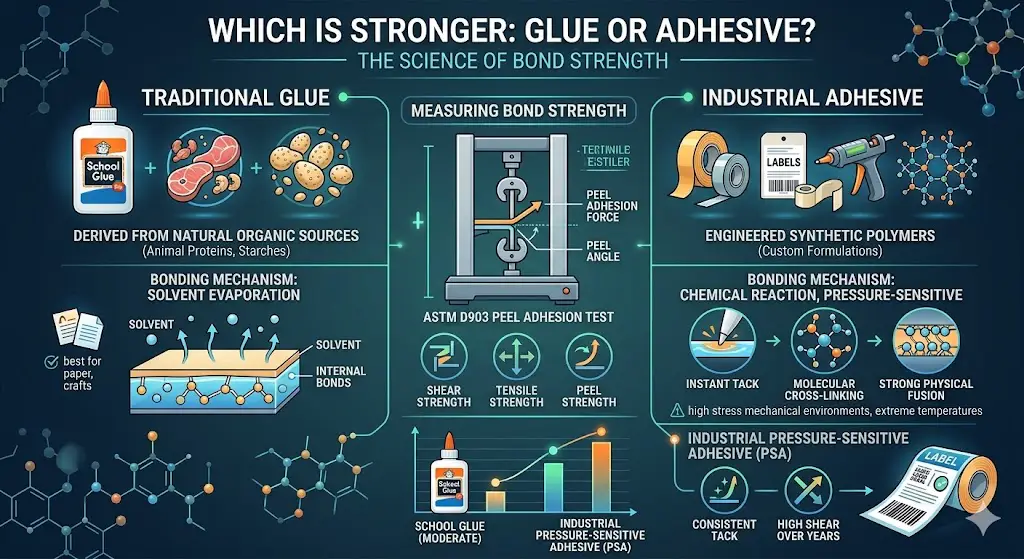
In a technical context, adhesives are generally stronger and more versatile than traditional glues. While glues are typically derived from natural organic sources (like animal proteins or starches) and bond via solvent evaporation, industrial adhesives are synthetic polymers designed for specific shear, tensile, and peel strengths, often outperforming glues in extreme temperatures and high-stress mechanical environments.
The strength of a bond is measured using ASTM D903 peel adhesion tests. When we compare a standard school glue to an industrial Pressure-Sensitive Adhesive (PSA), the PSA’s ability to maintain a consistent “tack” and “shear” over years of shelf life makes it the superior choice for high-performance labeling.
What is the Strongest Adhesive?
The strongest industrial adhesives are Structural Epoxies and Cyanoacrylates, capable of reaching tensile strengths exceeding 3,000 PSI. However, in the self-adhesive industry, the “strongest” is defined by High-Shear Acrylic PSAs, which provide a permanent, tamper-evident bond that can withstand chemical exposure and temperatures ranging from -40°C to +150°C without delaminating.
For specialized sectors like medical and pharmaceutical labeling, strength must be balanced with biocompatibility. A “strong” adhesive is useless if it migrates through the primary packaging. This is why we focus on low-migration, high-tack formulations that pass rigorous ISO 10993 testing.
Which Tape is Self-Adhesive But Not Sticky?
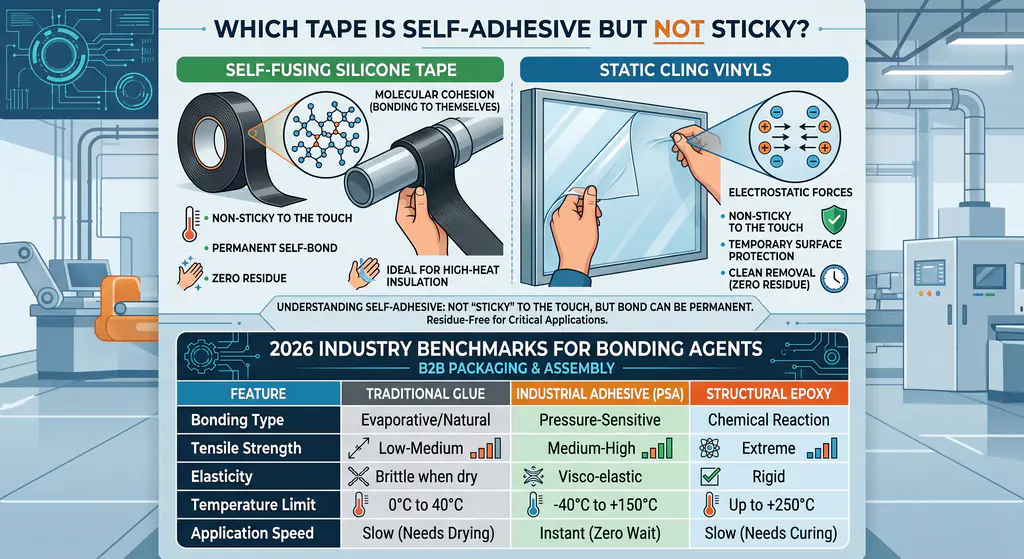
Self-fusing silicone tapes and static cling vinyls are self-adhesive but not “sticky” in the traditional sense. These materials rely on molecular cohesion (bonding to themselves) or electrostatic forces rather than a tacky chemical coating. They are ideal for high-heat insulation or temporary surface protection where zero residue is a non-negotiable requirement.
This data represents the 2026 industry benchmarks for bonding agents used in B2B packaging and assembly.
| Feature | Traditional Glue | Industrial Adhesive (PSA) | Structural Epoxy |
|---|---|---|---|
| Bonding Type | Evaporative/Natural | Pressure-Sensitive | Chemical Reaction |
| Tensile Strength | Low-Medium | Medium-High | Extreme |
| Elasticity | Brittle when dry | Visco-elastic | Rigid |
| Temperature Limit | 0°C to 40°C | -40°C to +150°C | Up to +250°C |
| Application Speed | Slow (Needs Drying) | Instant (Zero Wait) | Slow (Needs Curing) |
The Molecular Science: Why Adhesives Win in B2B
To truly understand glue vs adhesive: which is stronger, we must look at the cross-linking of polymers. Traditional glues often rely on a mechanical lock—where the liquid seeps into pores and hardens. Adhesives, specifically those used in Jumelage’s high-performance label rolls, utilize van der Waals forces and chemical covalent bonding.
1. Visco-elasticity (The “Secret Sauce”)
Unlike glue, which becomes a rigid solid, a Pressure-Sensitive Adhesive (PSA) remains in a “permanently tacky” state. This allows the bond to absorb mechanical shocks and thermal expansion without cracking. This is why adhesives are preferred in Cold Chain logistics, where materials shrink and expand violently.
2. Surface Energy Matching
Industrial adhesives can be “tuned” to the surface energy of the substrate. Whether you are bonding to high-energy glass or low-energy polyethylene (PE), a synthetic adhesive can be formulated to “wet out” the surface, creating a far stronger bond than a one-size-fits-all glue. This technical nuance is a core part of our BPA-Free Thermal Paper production protocol.
Choosing the Right Bond for Your Supply Chain
When selecting between glue vs adhesive: which is stronger for your specific application, consider the “Four Pillars of Adhesion”:
- Tack: The initial “grab” upon contact.
- Peel: The force required to remove the label (see our removal guide).
- Shear: The internal strength of the adhesive to resist sliding.
- Weatherability: Resistance to UV, moisture, and oxidation (see how long self-adhesives last).
For the majority of B2B labeling and flexible packaging needs, the synthetic acrylic adhesive is the undisputed champion of efficiency and durability. It eliminates the mess of liquid glues and the wait time of structural epoxies.
Engineering the Perfect Interface
In the debate of glue vs adhesive: which is stronger, the winner is determined by the environment. For industrial packaging that must survive a global supply chain, synthetic adhesives offer a level of reliability that traditional glues simply cannot match.
At Jumelage, we bridge the gap between French design precision and Chinese manufacturing scale. By integrating ISO 9001 quality standards with our proprietary PSA formulations, we ensure that your brand’s first point of contact—the label—remains unshakeable.
