
Table of Contents
In the pharmaceutical and life sciences sectors, the integrity of a label is as critical as the contents of the vial. When biological samples, vaccines, or cell therapies are stored at temperatures as low as -196°C (Liquid Nitrogen), standard labeling materials fail. This is where cold chain medical self-adhesive materials become the final line of defense in patient safety and supply chain traceability.
At Jumelage, our China-France joint venture expertise allows us to manufacture specialized materials within a 35,000㎡ GMP-certified facility. In this 2026 guide, we explore the science behind cold chain medical self-adhesive materials, focusing on adhesive rheology, substrate stability, and regulatory compliance.
This article is for general information, not medical advice. For wound closure, infection risk, and injury care, follow local clinical guidance or consult a qualified clinician.
What are Cold Chain Medical Self-Adhesive Labels?
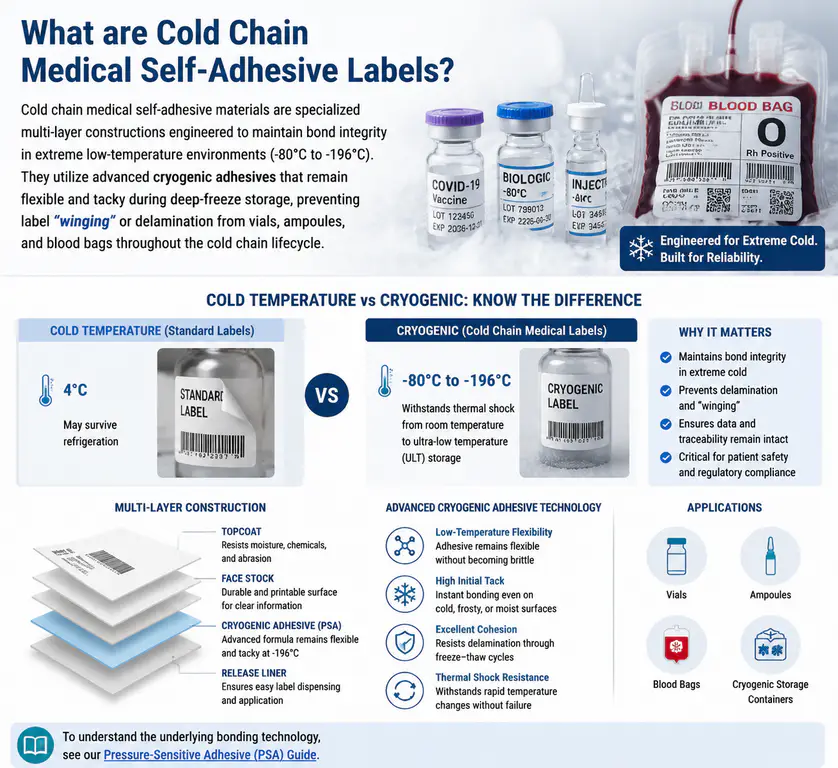
Cold chain medical self-adhesive materials are specialized multi-layer constructions engineered to maintain bond integrity in extreme low-temperature environments (-80°C to -196°C). They utilize advanced cryogenic adhesives that remain flexible and tacky during deep-freeze storage, preventing label “winging” or delamination from vials, ampoules, and blood bags throughout the cold chain lifecycle.
Understanding the difference between “cold temperature” and “cryogenic” is vital. While a standard label might survive a refrigerator (4°C), only cold chain medical self-adhesive materials can withstand the thermal shock of being moved from room temperature to ultra-low temperature (ULT) storage. To understand the underlying bonding technology, see our Pressure-Sensitive Adhesive (PSA) Guide.
Why Standard Adhesives Fail in the Cold Chain?
The failure of a label in a medical context is often caused by a phenomenon known as the Glass Transition Temperature (Tg). When the environment drops below the adhesive’s Tg, the material becomes brittle and loses its “visco-elastic” properties.
1. Adhesive Embrittlement
Standard adhesives harden into a glass-like state. Once brittle, any mechanical stress—such as handling a frozen vial—causes the bond to snap. Professional cold chain medical self-adhesive materials utilize specially formulated acrylic or rubber-based adhesives with an ultra-low Tg, ensuring they stay elastic even in liquid nitrogen.
2. Condensation and Surface Energy
A major challenge in cold chain medical self-adhesive materials is moisture. When a vial is removed from storage, frost or condensation forms instantly. Cryogenic labels are often designed to be applied at room temperature and then survive the freeze, or even applied directly to slightly frosted surfaces. We discuss the mechanics of this in our guide: What is pressure-sensitive labeling?.
This table provides a benchmark for selecting cold chain medical self-adhesive materials based on specific thermal requirements.
| Material Grade | Temp Range | Sterilization Mode | Compliance |
|---|---|---|---|
| **Cryo-PET White** | -196°C to +120°C | Autoclave, Gamma | FDA 175.105 |
| **Deep-Freeze PP** | -80°C to +90°C | EtO, Gamma | GMP, ISO 10993 |
| **Thermal Transfer Paper** | -40°C to +70°C | N/A | BPA-Free, RoHS |
Regulatory Compliance and GMP Standards
When sourcing cold chain medical self-adhesive materials, compliance is non-negotiable. At Jumelage, we adhere to international
- ISO 10993 (Biocompatibility): Ensures that the adhesive components do not pose a toxicological risk if they come into contact with the skin or the drug environment.
- FDA 21 CFR 175.105: Our adhesives meet the requirements for indirect food and drug contact.
- Low-Migration Adhesives: Essential for thin-walled plastic containers, our cold chain medical self-adhesive materials prevent chemical leaching. Learn more about material safety in our GMP Medical Labels Guide.
The Importance of Shelf Life in Pharma
In a medical supply chain, labels may be stored for months before use. Understanding how long self-adhesives last in storage is critical to avoiding application failure when the clinical trial or vaccine rollout begins.
Best Practices for Applying Cryogenic Labels
To maximize the performance of cold chain medical self-adhesive materials, follow these technical protocols:
- Room Temp Application: Always apply the label to a clean, dry surface at room temperature (approx. +20°C) before freezing. This allows the adhesive to “wet out” and reach its maximum bond strength.
- Mandrel Performance: For small diameter vials (less than 15mm), use high-conformability films (like PE or thin PP) to prevent “label lift” caused by the memory of the facestock.
- Thermal Transfer Ribbon Selection: Ensure you use a high-durability resin ribbon that is compatible with your cold chain medical self-adhesive materials to prevent data loss during alcohol wipes or abrasion.
For a broader look at material selection, consult our Self-Adhesive Packaging Materials Guide.
Securing the Life Science Supply Chain
As global health challenges evolve, the demand for high-performance cold chain medical self-adhesive materials continues to rise. Whether it’s supporting the transport of mRNA vaccines or the long-term storage of stem cells, the material choice is a critical engineering decision.
At Jumelage, we are committed to providing materials that endure the most hostile environments. Explore our Full Technical Catalog or contact our material scientists for a Peel Strength Test report on your specific substrate.
