
Table of Contents
n the high-precision world of electronics, automotive assembly, and heavy industrial processing, thermal management is a critical safety and traceability requirement. For procurement managers and quality engineers, the choice of a high temperature label is often the deciding factor in maintaining product integrity through hostile environments. Standard labels that thrive in warehouse conditions will shrink, char, or delaminate when exposed to the extreme thermal loads of a solder reflow oven or an engine compartment.
At Jumelage, our China-France joint venture heritage and 35,000㎡ GMP-certified facility allow us to engineer materials that don’t just “survive” heat—they maintain high-performance bond strength at molecular levels. In this 2026 guide, we analyze the materials, classifications, and failure modes of high temperature labels to help you secure your production traceability.
High temperature labels are essential for maintaining traceability in 2026’s extreme industrial environments. In the high-precision world of electronics…
What Temperature Can Labels Withstand?
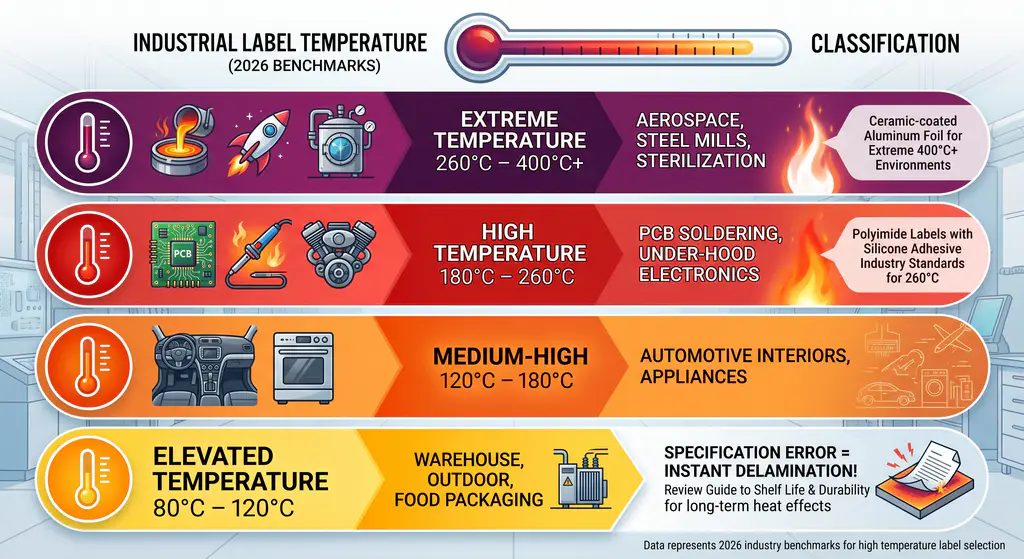
Standard paper labels typically fail above 80°C. High temperature labels are classified by range: Elevated (80-120°C), Medium-High (120-180°C), High (180-260°C), and Extreme (260-400°C+). Polyimide labels with silicone adhesive are industry standards for 260°C continuous service, while ceramic-coated aluminum foils are required for extreme industrial environments reaching 400°C or higher.
Understanding the classification system is vital for avoiding specification errors. A label rated for “Elevated” temperatures used in a “High” temperature PCB process will lead to instant delamination. For high-reliability environments, we recommend reviewing our Guide to Shelf Life and Durability to understand how long-term heat affects adhesive lifespan.
The table below provides an engineering benchmark for high temperature label selection across 2026 industrial standards.
| Temperature Class | Range | Typical Applications |
|---|---|---|
| Elevated Temperature | 80°C – 120°C | Warehouse, Outdoor, Food Packaging |
| Medium-High | 120°C – 180°C | Automotive Interiors, Appliances |
| High Temperature | 180°C – 260°C | PCB Soldering, Under-hood Electronics |
| Extreme Temperature | 260°C – 400°C+ | Aerospace, Steel Mills, Sterilization |
What Materials are Used for High Temperature Labels?
High temperature labels utilize advanced facestocks such as PET film (up to 150°C), polyimide (up to 260°C), aluminum foil (up to 300°C), and ceramic-coated materials (400°C+). These are paired with specialized adhesives—primarily silicone formulations—which maintain flexibility and bond strength from -60°C to +260°C, resisting thermal embrittlement.
The facestock material dictates the label’s dimensional stability. For electronics manufacturing, polyimide (often known by the brand name Kapton®) is the gold standard for PCB identification. For automotive exhaust systems or heavy machinery, aluminum foils are preferred for their barrier properties and heat-reflective surfaces. Learn more about these material choices in our B2B Packaging Materials Guide.
Why Do Standard Labels Fail at High Temperatures?
Standard labels fail due to adhesive softening, where the acrylic bond turns into a viscous liquid above its glass transition temperature, causing slippage or delamination. Furthermore, paper facestocks lose moisture and curl, while synthetic films like BOPP shrink. Thermal exposure also causes chemical oxidation in standard adhesives, leading to long-term brittleness and print degradation.
Diagnosing a field failure requires understanding these mechanisms. If a label “oozes” adhesive at 100°C, it is a sign that the high temperature label was improperly specified with a low-Tg acrylic. In contrast, specialized heat-resistant adhesives maintain their visco-elastic state, ensuring the label stays in place through multiple thermal cycles.
Key Applications in B2B Manufacturing
- Electronics Assembly (PCB): Labels must survive wave soldering and reflow processes. Failure to use a certified high temperature label leads to unreadable barcodes and lost traceability.
- Automotive Under-hood: Engine covers and fuse boxes experience constant thermal cycling. PET labels with silicone adhesive are often specified to meet these rigorous demands.
- Medical Sterilization: Autoclave processes (134°C) require moisture-resistant, heat-stable labels. For these sensitive environments, we recommend our GMP Certified Medical Label Guide.
Selecting a high temperature label involves more than just heat resistance; chemical exposure at peak temperatures is a common failure point. During the wave soldering process, labels are exposed to aggressive fluxes and cleaning solvents. A standard label’s adhesive would swell and release. Jumelage’s high temperature labels are engineered with cross-linked polymers that resist solvent penetration, maintaining a BPA-Free environment even under chemical stress.
Securing Your Thermal Supply Chain
In 2026, the demand for high-reliability identification is higher than ever. Choosing the correct high temperature label is an engineering decision that impacts your entire supply chain’s efficiency. By matching the right facestock (Polyimide, PET, or Foil) with a thermally stable adhesive, you eliminate the risk of label failure in critical moments.
Explore our Full Technical Catalog or contact the Jumelage engineering team today to run a Peel Adhesion Test for your specific high-heat environment.
