
Table of Contents
Is Self-Adhesive Easy to Remove?
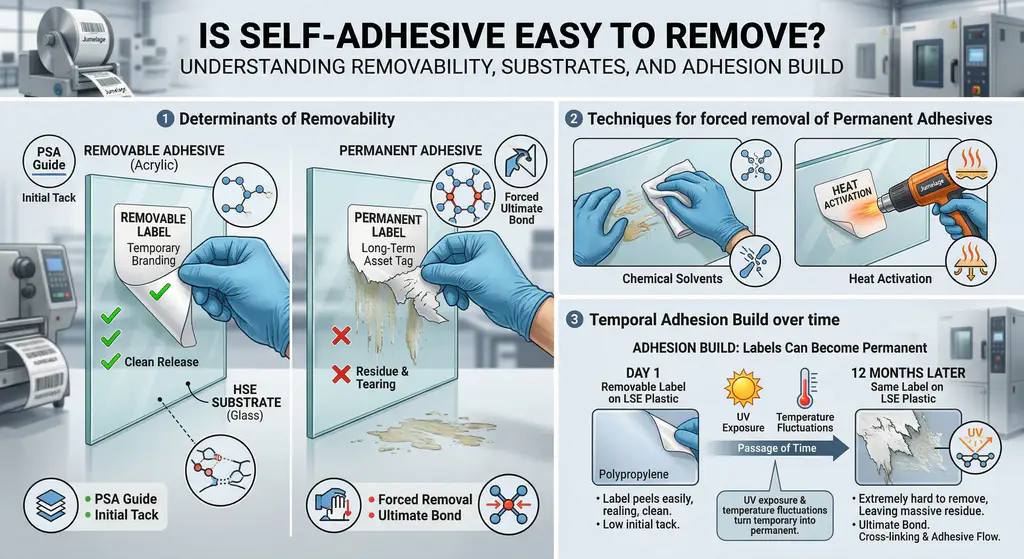
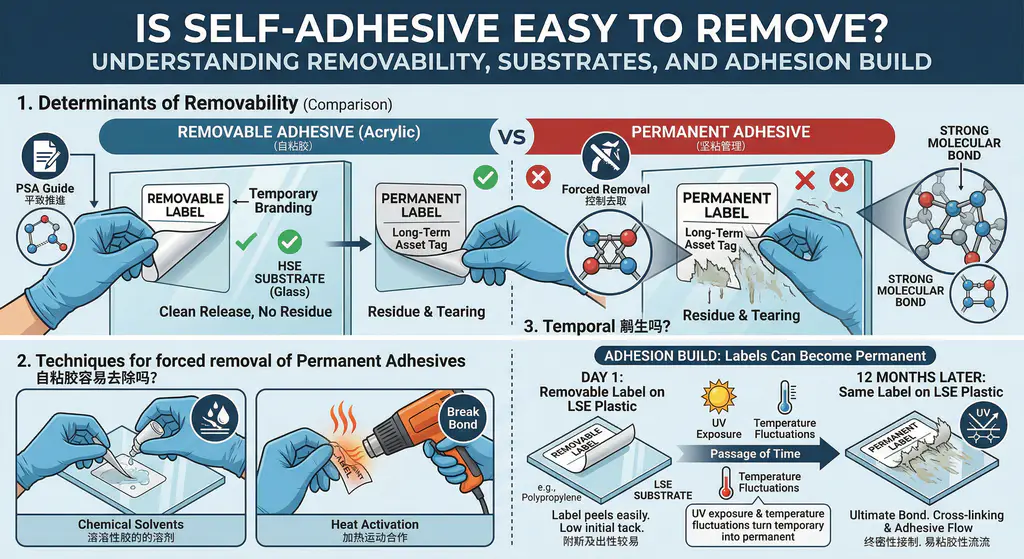
Whether is self-adhesive easy to remove depends primarily on the adhesive formulation (Permanent vs. Removable) and the surface energy of the substrate. While removable acrylics are engineered for clean release, permanent adhesives require chemical solvents or heat to break the molecular bond without leaving a sticky residue on the surface.
The “ease of removal” is not a static property. A label that is easy to remove today might become permanent after 12 months of UV exposure or temperature fluctuations. This phenomenon, known as “adhesion build,” is documented in international testing standards like ISO 29862:2018, which specifies the determination of peel adhesion properties. This is why selecting the correct initial tack in our Pressure-Sensitive Adhesive (PSA) Guide is vital for temporary applications.
Chemical compatibility between the facestock coating and the adhesive determines the long-term archival quality of a label. Explore how we match TPF paper with the right adhesives in our engineering breakdown: The Ultimate Guide to Self-Adhesive Packaging Materials: Adhesives, Liners & Facestocks ➔
What Removes Self-Adhesive Glue?
When evaluating is self-adhesive easy to remove, the solvent type is key.To remove stubborn self-adhesive glue, you must use a solvent that matches the adhesive’s chemistry. Isopropyl alcohol (IPA) works best for acrylic residues, while hydrocarbon-based cleaners or citrus oils are more effective for rubber-based glues. Always apply the solvent to a cloth first to avoid damaging the underlying material.
When evaluating is self-adhesive easy to remove, one must consider the type of solvent required for residue-free results. In industrial environments, mechanical removal (scraping) often causes micro-scratches on sensitive surfaces like stainless steel. Therefore, we recommend a “Soak and Wipe” protocol. By allowing a specialized adhesive remover to dwell on the glue for 2-3 minutes, you weaken the polymer chains—a process supported by chemical safety guidelines from the European Chemicals Agency (ECHA).
Does WD-40 Remove Sticky Adhesive?
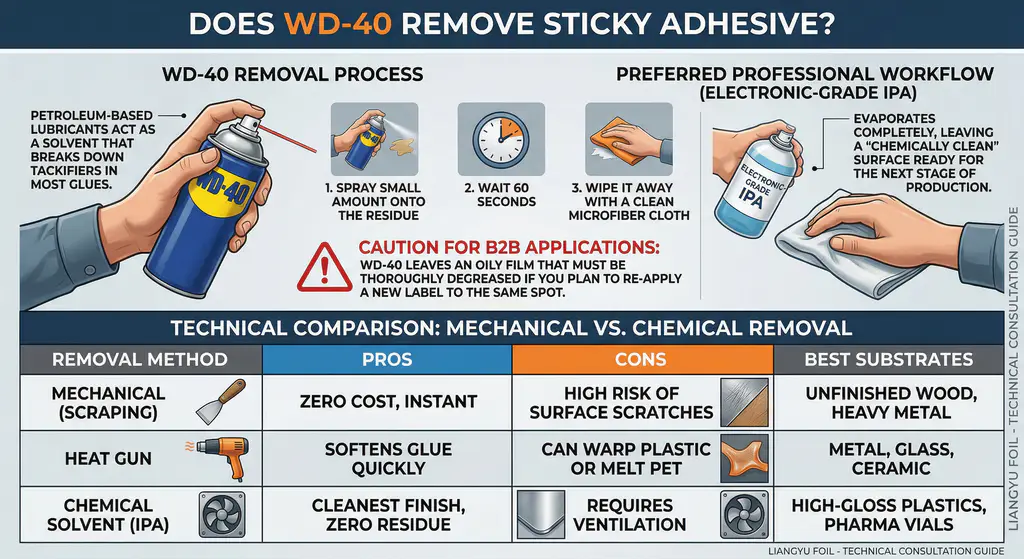
Yes, WD-40 is highly effective at removing sticky adhesive residues because its petroleum-based lubricants act as a solvent that breaks down the tackifiers in most glues. Simply spray a small amount onto the residue, wait 60 seconds, and wipe it away with a clean microfiber cloth.
However, a word of caution for B2B applications: WD-40 leaves an oily film that must be thoroughly degreased if you plan to re-apply a new label to the same spot. In professional labeling workflows, we prefer Electronic-Grade IPA because it evaporates completely, leaving a “chemically clean” surface ready for the next stage of production.
The broader answer to is self-adhesive easy to remove depends on the balance between solvent and surface.
Technical Comparison: Mechanical vs. Chemical Removal
The comparison below explains why is self-adhesive easy to remove in some contexts but not others.
| Removal Method | Pros | Cons | Best Substrates |
|---|---|---|---|
| Mechanical (Scraping) | Zero cost, instant | High risk of surface scratches | Unfinished wood, heavy metal |
| Heat Gun | Softens glue quickly | Can warp plastic or melt PET | Metal, Glass, Ceramic |
| Chemical Solvent (IPA) | Cleanest finish, zero residue | Requires ventilation | High-gloss plastics, Pharma vials |
The data above explains why is self-adhesive easy to remove in some contexts.
Is Self-Adhesive the Same as Peel and Stick?
Technically, yes—they refer to the same technology. “Self-adhesive” is the industrial term used by manufacturers and engineers, while “peel and stick” is a consumer-friendly description. Both rely on pressure-sensitive adhesives (PSA) that do not require water, heat, or solvents to activate their bonding properties.
The distinction matters in your procurement specifications. If your technical requirement is for a label that survives -40°C, searching for “peel and stick” will lead to consumer-grade products that fail in industrial environments. Specifying “Self-adhesive material with cryogenic acrylic adhesive” ensures you receive a product engineered for the demands of the cold chain.
How Long Do You Leave an Adhesive Remover On?
For optimal results, you should leave an adhesive remover on the surface for 2 to 5 minutes. This dwell time is necessary for the chemicals to penetrate the thickness of the residue and reach the bond interface. For thicker, aged glues, a second application and a longer dwell time may be required.
Rushing this process is the primary cause of surface damage. When you force a label off before the solvent has acted, you risk “cohesive failure,” where the adhesive splits, leaving half the glue on the label and half on your product. At Jumelage, we test our Removable PSA series to ensure they achieve a 99.8% clean-peel rate without the need for any chemical assistance. By using the right dwell time, you ensure that even the strongest is self-adhesive easy to remove without any permanent marks.
Choosing Materials to Minimize Post-Purchase Hassle
The best way to ensure is self-adhesive easy to remove is to avoid permanent glues for temporary applications.
- Select “Wash-off” Adhesives: Ideal for the recycling industry, these adhesives release completely when exposed to warm water and mild friction.
- Verify Surface Compatibility: High-energy surfaces like glass bond much more strongly than low-energy surfaces like polyethylene (PE).
- Audit the Factory: In our 35,000㎡ GMP-certified facility, we perform aging tests to simulate removal after 6, 12, and 24 months. This data allows us to provide our B2B partners with a “Clean Removal Guarantee” for specific product lines, many of which utilize FSC-certified sustainable liners.
By following these technical steps, you can confidently answer is self-adhesive easy to remove with a resounding ‘yes’ for your brand. By integrating the right chemistry from the start, you ensure that your products remain as professional during the removal phase as they did the day the label was first applied.
By choosing the right PSA, answering is self-adhesive easy to remove becomes a guarantee.
Secure Your Residue-Free Supply Chain
Don’t let a “sticky situation” damage your brand reputation. Partner with Jumelage for engineered PSA solutions where is self-adhesive easy to remove is a guarantee, not a gamble.
