
Table of Contents
- 1. Are Pressure-Sensitive and Self-Adhesive Labels the Same Thing?
- 2. What Does "Pressure-Sensitive" Mean Technically?
- 3. What Does "Self-Adhesive" Mean in Industry Terms?
- 4. The Key Difference: Mechanism vs Construction
- 5. When to Specify Pressure-Sensitive vs Self-Adhesive
- 6. Industry Standards and Testing Methods
- 7. B2B Procurement: Getting Your Specifications Right
Understanding the difference between **pressure-sensitive vs self-adhesive labels** is essential for procurement managers in the labeling industry. While these terms are often used interchangeably, they describe different aspects of the same technology—and using them incorrectly can lead to specification errors, compliance issues, and supply chain disruptions.
At Jumelage, we engineer both pressure-sensitive adhesive systems and self-adhesive label constructions for global manufacturers. This guide clarifies the technical relationship between these terms, explains when to use each specification, and provides the engineering knowledge needed to communicate accurately with suppliers and converters.
This article is for general information, not medical advice. For wound closure, infection risk, and injury care, follow local clinical guidance or consult a qualified clinician.
Are Pressure-Sensitive and Self-Adhesive Labels the Same Thing?
In practical usage, yes. Technical answer: They describe different aspects of the same technology.
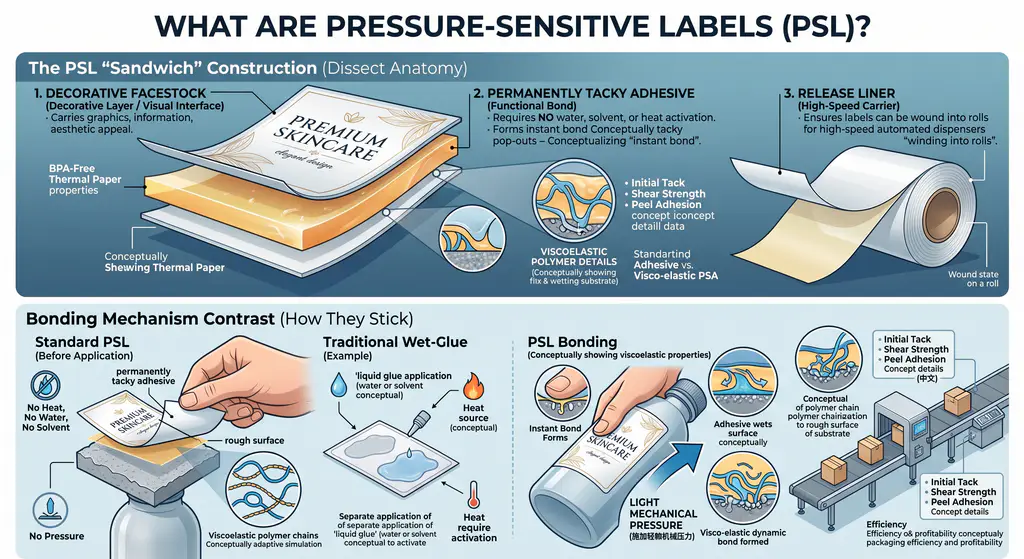
In the labeling industry, “pressure-sensitive” and “self-adhesive” are often used interchangeably because they refer to the same fundamental technology: labels that adhere to surfaces through the application of pressure alone, without requiring heat, water, or solvents for activation.
In the labeling industry, “pressure-sensitive” and “self-adhesive” are often used interchangeably because they refer to the same fundamental technology: labels that adhere to surfaces through the application of pressure alone, without requiring heat, water, or solvents for activation.
However, from an engineering and procurement perspective, the terms have distinct connotations:
- “Pressure-sensitive” emphasizes the adhesive mechanism—the physical chemistry that creates the bond
- “Self-adhesive” emphasizes the product construction—the complete label assembly ready for application
Understanding this distinction matters when writing technical specifications, requesting quotes, or communicating with international suppliers who may use these terms differently based on regional industry conventions.
For a broader comparison of adhesive terminology, see our guide on Self-Adhesive vs. Adhesive: 5 Crucial B2B Differences.
What Does "Pressure-Sensitive" Mean Technically?
Pressure-sensitive adhesive (PSA) refers to a specific class of adhesives that form a bond when pressure is applied between the adhesive and a substrate. The term describes the adhesive technology itself, not the complete label construction.
The Science of Pressure-Sensitivity
Pressure-sensitive adhesive (PSA) refers to a specific class of adhesives that form a bond when pressure is applied between the adhesive and a substrate. The term describes the adhesive technology itself, not the complete label construction.
- Flow under pressure to make intimate contact with surface irregularities (microscopic-level wetting)
- Resist flow under static conditions to maintain bond strength (cohesion)
According to the Pressure Sensitive Tape Council (PSTC), a true pressure-sensitive adhesive must display:
- Permanent tack (sticky to the touch at room temperature)
- Adhesion with only pressure (no heat, water, or solvent required)
- Sufficient cohesion to hold the bond under stress
- Elasticity to accommodate some substrate movement
Common PSA Chemistries in Labeling
| Adhesive Type | Key Characteristics | Best Applications |
|---|---|---|
| Acrylic PSA | Excellent UV resistance, clear aging, moderate initial tack | Outdoor labels, long-term durability needs |
| Rubber-Based PSA | High initial tack, lower cost, susceptible to oxidation | Indoor applications, short-term labels |
| Silicone PSA | Extreme temperature range, chemical resistance, premium cost | Medical devices, harsh environments |
| Hot Melt PSA | High tack, fast setting, good for low-energy surfaces | Logistics, retail, general purpose |
For a deep dive into PSA formulations, refer to our Ultimate Engineering Guide to Pressure-Sensitive Adhesive (PSA) Formulations.
What Does "Self-Adhesive" Mean in Industry Terms?
Self-adhesive describes the complete label construction—a multi-layer assembly that includes a facestock (the printable layer), an adhesive layer (typically PSA), and a release liner (the protective backing). The term emphasizes that the product is “ready to stick” without additional activation steps.
The Three-Layer Construction
A self-adhesive label consists of:
- Facestock: Paper, film, or foil that receives the printed image
- Adhesive: The pressure-sensitive layer that creates the bond
- Release Liner: Silicone-coated paper or film that protects the adhesive until application
This construction is what distinguishes self-adhesive labels from other labeling technologies like:
- Wet-glue labels (require adhesive application during labeling)
- Heat-activated labels (require thermal activation)
- In-mold labels (integrated during container manufacturing)
Why “Self-Adhesive” Became the Preferred Term
The term “self-adhesive” gained popularity because it describes the user experience—the label sticks by itself. This consumer-friendly terminology became standard in retail and packaging markets, even though the underlying technology is pressure-sensitive adhesion.
For a complete explanation of self-adhesive terminology, see What Does Self-Adhesive Mean? The Essential 2026 Industry Guide.
The Key Difference: Mechanism vs Construction
When comparing pressure-sensitive vs self-adhesive, the fundamental distinction is the scope of what each term describes:
| Aspect | Pressure-Sensitive | Self-Adhesive |
|---|---|---|
| What it describes | The adhesive technology/mechanism | The complete label product |
| Technical focus | Adhesion science, chemistry | Product construction, usability |
| Industry usage | Adhesive manufacturers, R&D, technical specs | Label converters, brand owners, marketing |
| Specification context | “Pressure-sensitive adhesive with 20 oz/in peel strength” | “Self-adhesive label on 50# gloss paper” |
| Regional preference | North America, technical documentation | Europe, Asia, consumer-facing materials |
Analogy for Clarity
Think of the relationship this way:
- Pressure-sensitive = “Fuel injection engine” (the technology)
- Self-adhesive = “Car” (the complete product that uses the technology)
Every self-adhesive label uses pressure-sensitive adhesive, but not every pressure-sensitive adhesive application is a self-adhesive label (PSAs are also used in tapes, medical dressings, automotive trim, and hundreds of other applications).
When to Specify Pressure-Sensitive vs Self-Adhesive
Knowing when to use pressure-sensitive vs self-adhesive in your specifications depends on your audience and context:
- Writing technical specifications for the adhesive layer specifically
- Communicating with adhesive manufacturers or chemists
- Discussing adhesion performance (tack, peel, shear)
- Referencing industry standards (PSTC, AFERA, FINAT)
- Specifying adhesive properties for unique applications
Example specification: “Label shall utilize permanent acrylic pressure-sensitive adhesive with minimum 24-hour 180° peel adhesion of 2.5 N/cm per FINAT FTM 1.”
Use “Self-Adhesive” When:
- Describing the complete label product to converters or printers
- Ordering standard label constructions from suppliers
- Communicating with brand managers or marketing teams
- Writing consumer-facing documentation
- Referring to the general product category
Example specification: “Self-adhesive label, 4″ x 6″, white semi-gloss paper facestock, permanent adhesive, 40# liner.”
| Region | Preferred Terminology | Context |
|---|---|---|
| North America | Pressure-sensitive label | Technical and commercial usage |
| Europe | Self-adhesive label | Standard industry terminology |
| Asia-Pacific | Self-adhesive label | Following European convention |
| Global Technical | Pressure-sensitive adhesive (PSA) label | Scientific and engineering documents |
Industry Standards and Testing Methods
Both terms appear in industry standards, often depending on the issuing organization’s geographic origin:
- FINAT (Europe): Uses “self-adhesive” in commercial contexts but “pressure-sensitive” in technical test methods (FINAT FTM)
- PSTC (North America): Uses “pressure-sensitive” exclusively
- AFERA (Europe): Uses “self-adhesive” as the primary term
- TLMI (North America): Uses “pressure-sensitive” in technical contexts
Key Test Methods
Regardless of terminology, the testing methods are standardized:
- Peel Adhesion: FINAT FTM 1, PSTC-101, ASTM D3330
- Shear Resistance: FINAT FTM 2, PSTC-107, ASTM D3654
- Tack: FINAT FTM 9, PSTC-5, ASTM D3121
- Release Force: FINAT FTM 10, TLMI L-IB1
These test methods define pressure-sensitive adhesive performance, whether the final product is called a “pressure-sensitive label” or a “self-adhesive label.”
B2B Procurement: Getting Your Specifications Right
Common Specification Errors
- Requesting “pressure-sensitive labels” when you need specific adhesive performance
- Better: Specify the adhesive chemistry and performance requirements
- Using “self-adhesive” in technical performance specifications
- Better: Use “pressure-sensitive adhesive” when discussing adhesion science
- Assuming regional suppliers understand your preferred term
- Better: Clarify both terms in international communications
Recommended Specification Language
For North American Suppliers:
“Pressure-sensitive labels with permanent acrylic adhesive, 2.0 mil clear BOPP facestock, 50# densified kraft liner.”
For European/Asian Suppliers:
“Self-adhesive labels with permanent acrylic pressure-sensitive adhesive, 50 micron clear BOPP facestock, 80 gsm glassine liner.”
For Global Technical Documentation:
“Labels utilizing pressure-sensitive adhesive technology, self-adhesive construction, permanent bonding characteristics.”
| Your Situation | Recommended Term |
|---|---|
| Writing technical adhesive specifications | Pressure-sensitive adhesive |
| Ordering standard label products | Self-adhesive label |
| Communicating with European suppliers | Self-adhesive |
| Communicating with North American suppliers | Pressure-sensitive |
| Marketing to end consumers | Self-adhesive |
| Technical documentation or patents | Pressure-sensitive adhesive (PSA) |
Ready to Specify Your Label Requirements?
Request technical samples and adhesive performance data for your specific application.
