
Table of Contents
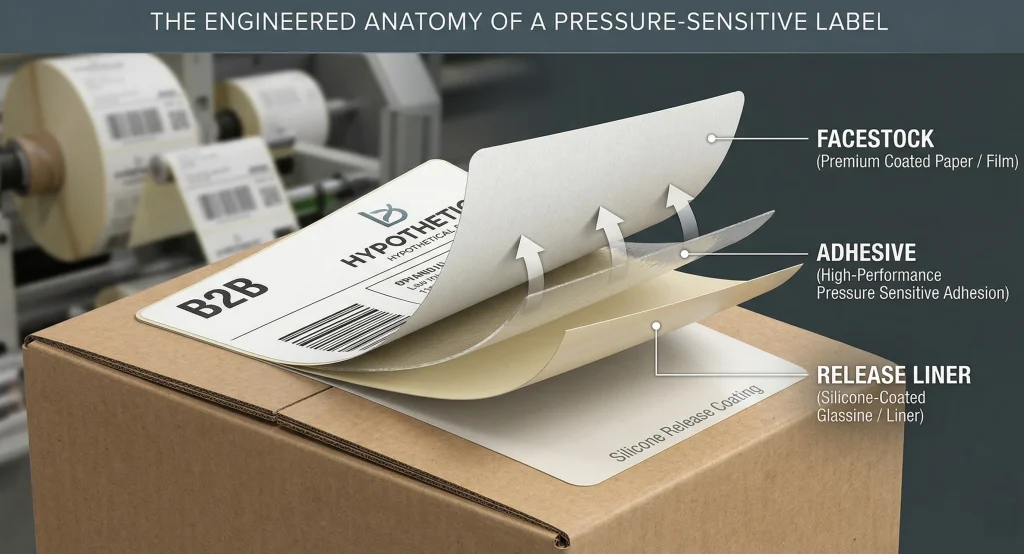
The Anatomy of a Self-Adhesive Label
- The Facestock: The carrier of information and the primary shield against UV, moisture, and abrasion.
- The Adhesive (PSA): The engine that drives the bond. In 2026, the industry is shifting toward high-performance pressure-sensitive adhesive formulations that offer both initial tack and long-term shear strength.
- The Release Liner: The foundation that allows for precision slitting and high-speed automated application.
Facestocks: Choosing the Right Look and Durability
When selecting Self-Adhesive Packaging Materials, the choice of facestock must align with the container’s surface energy and environmental exposure.
Paper vs. Film: A Technical Trade-off
For cost-effective, high-volume shipping labels, Thermal Paper or Semi-Gloss remains the standard. However, for the chemical and cosmetic industries, PET and BOPP films are preferred due to their superior resistance to oils and solvents. For advanced recycling needs, exploring Wash-off Adhesive solutions on PET facestocks is now a strategic requirement for circularity.
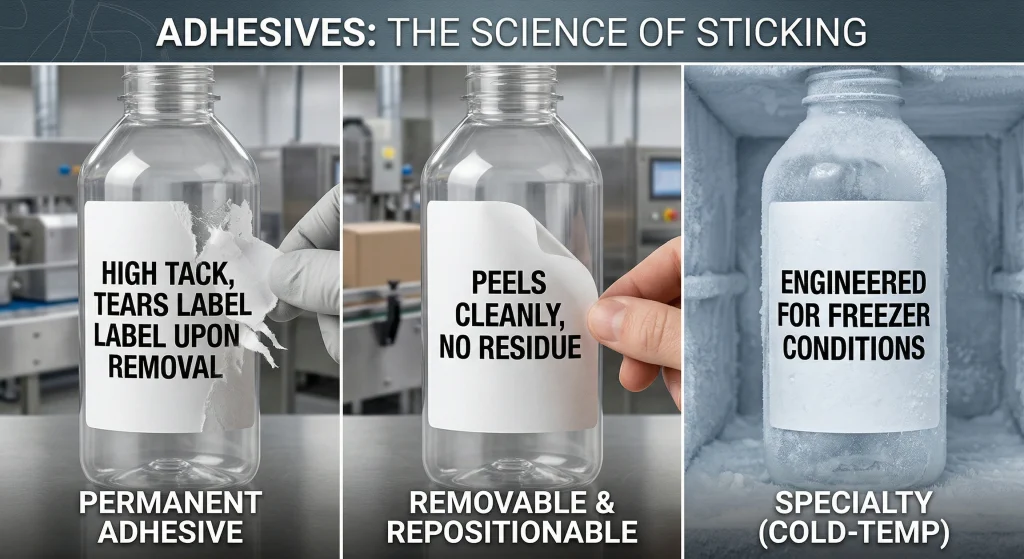
Adhesives: The Science of Sticking
The right adhesive depends entirely on the surface energy of your container and the environment it will endure.
- Permanent Adhesives: High initial tack and strong holding power. Designed to tear the label if removal is attempted.
- Removable & Repositionable: Formulated to peel off cleanly without leaving residue behind, crucial for temporary promotional labels.
- Specialty (Cold-Temp/Wash-off): Engineered for freezer conditions (-20°C and below) or eco-friendly wash-off recycling processes.
Release Liners: The Unsung Hero of Automated Dispensing
For label printing plants, the release liner is the unsung hero. A consistent release force is mandatory to prevent “web breaks” during automated dispensing. While Glassine is the standard for roll-to-roll printing, PET Liners are increasingly used for high-speed lines due to their extreme tensile strength and moisture stability.
The following table compares the release liners commonly used in high-speed Self-Adhesive Packaging Materials.
| Liner Type | Tensile Strength | Best For |
|---|---|---|
| Glassine (Paper) |
Medium | Standard speed roll-to-roll labeling. Cost-effective. |
| PET (Clear Film) |
Very High | High-speed automated dispensing. Prevents web breaks. |
Industry-Specific Selection Logic
The optimization of Self-Adhesive Packaging Materials varies significantly across sectors:
- Pharmaceuticals: Requires low-migration adhesives and sterilization-resistant facestocks to comply with FDA and GMP standards.
- Cold Chain Logistics: Requires “Deep Freeze” adhesives capable of maintaining a bond at -40°C without crystallizing.
- Wine & Spirits: Focuses on “Wet Strength” papers that maintain their aesthetic integrity even after hours in an ice bucket.
Ready to upgrade your packaging line?
The Critical Role of Surface Energy in Adhesive Bonding
Understanding how surface energy affects the bonding process is paramount when selecting industrial-grade Self-Adhesive Packaging Materials. Surface energy is a physical property of a substrate’s surface that determines its “attractiveness” to an adhesive, directly influencing how well a pressure-sensitive adhesive (PSA) can “wet out” and form a molecular bond.
In the world of industrial packaging, substrates are generally categorized into two groups:
- High Surface Energy (HSE): Materials like stainless steel, copper, and glass possess a high degree of molecular attraction. When an adhesive is applied to an HSE surface, it flows easily and maximizes the contact area, ensuring a permanent, high-strength bond.
- Low Surface Energy (LSE): Modern packaging often utilizes LSE plastics such as Polyethylene (PE) and Polypropylene (PP). On these surfaces, standard adhesives tend to “bead up” (similar to water on a waxed car), resulting in poor contact and eventual “label flagging” or edge lifting.
For a successful application, the surface energy of your container should ideally be at least 10 mN/m (dynes/cm) higher than the surface tension of the adhesive. If your production line utilizes LSE containers, your Self-Adhesive Packaging Materials must be specifically engineered with high-tack, modified acrylic or specialized rubber-based formulations designed to overcome the low molecular attraction. Ignoring this technical variable is the leading cause of dispensing failures in high-speed pharmaceutical and chemical labeling lines.
Technical FAQ for Procurement Directors
For label printing plants, the release liner is the unsung hero. A consistent release force is mandatory to prevent “web breaks” during automated dispensing. While Glassine is the standard for roll-to-roll printing, PET Liners are increasingly used for high-speed lines due to their extreme tensile strength and moisture stability.
How do I prevent label "flagging" on curved surfaces?
Flagging is usually caused by a mismatch between facestock stiffness and adhesive tack. For small-diameter vials, use high-conformability PE films paired with a high-shear PSA.
What is the shelf life of Self-Adhesive Packaging Materials?
Standard materials have a shelf life of 12-24 months when stored at 22°C and 50% relative humidity. Exposure to extreme heat can cause “adhesive bleed,” complicating the slitting process.
Are linerless labels a viable alternative?
Linerless labels reduce waste by 40% but require specialized thermal printers. They are currently best suited for logistics and retail weight-scale applications.
Request Your 2026 Technical Sample Book
Jumelage provides expert-grade Self-Adhesive Packaging Materials tested to FINAT and ASTM standards. Ensure your packaging line’s efficiency with our lab-verified jumbo rolls.
