
Table of Contents
If your customers have started asking whether your packaging is recyclable, you are not alone. Over the past three years, we have seen a sharp uptick in RFQs that include sustainability requirements, not as a nice-to-have, but as a contractual condition. The problem is that “eco-friendly” means different things to different people, and the self-adhesive industry has historically been anything but green. Between the silicone-coated release liner, the petrochemical-based adhesive, and the mixed-material face stock, a standard label can be a recycling nightmare.
At Jumelage, we have been producing self-adhesive materials for over twenty years, and we have watched the shift from purely cost-driven procurement to sustainability-aligned supply chains. This guide is based on what we have learned helping converters and brand owners navigate that transition without sacrificing performance or blowing their unit economics.
This article is for general information, not medical advice. For wound closure, infection risk, and injury care, follow local clinical guidance or consult a qualified clinician.
What Are 5 Sustainable Self-Adhesive Materials? A Manufacturer's Guide
If you have ever wondered whether self-adhesive labels can ever be truly eco-friendly, you are asking the right question. Most people assume that anything with glue attached is destined for landfill, and honestly, for a long time, that was the reality. The combination of silicone-coated liners, petroleum-based adhesives, and mixed-material face stocks made traditional labels a recycling nightmare. But the industry has changed more in the past five years than in the previous twenty.
At Jumelage, we have been manufacturing pressure-sensitive adhesive materials for over two decades, and we have watched sustainability shift from a marketing buzzword to a procurement requirement. In this guide, we break down the five sustainable self-adhesive materials that are actually viable for industrial-scale production today, what makes each one “sustainable,” and where each fits in the real world of packaging and labeling.
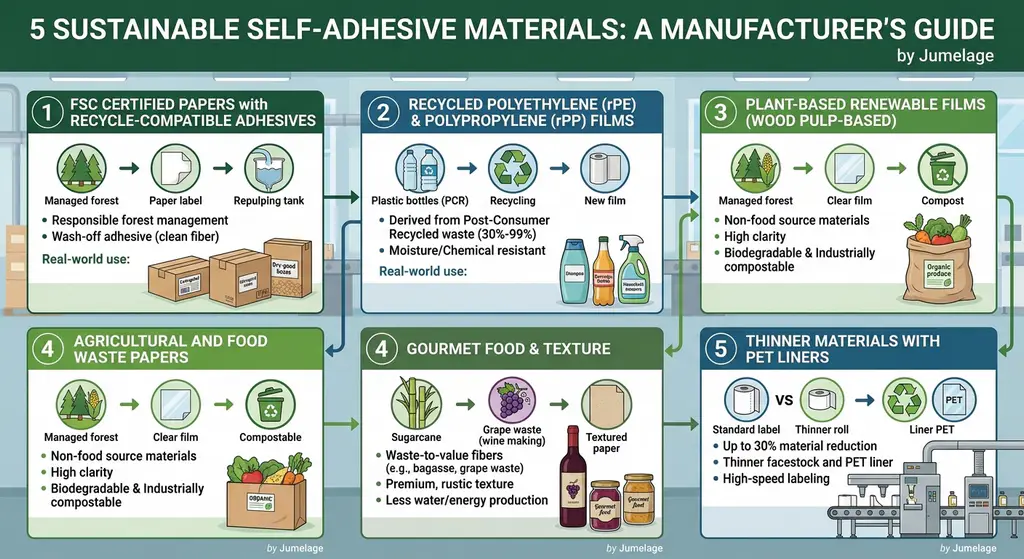
What Are Sustainable Self-Adhesive Materials?
Before we get to the list, we need to define what “sustainable” actually means in this context. Not all eco-friendly claims are equal. In the self-adhesive world, sustainability generally falls into four categories, and understanding the difference matters when you are specifying materials for a client or evaluating a supplier.
| Sustainability Type | Definition | Typical Application |
|---|---|---|
| Recyclable | Label and substrate can be processed through standard recycling streams without contamination | Beverage bottles, food containers |
| Recycled Content | Incorporates post-consumer or post-industrial waste into the face stock or liner | General packaging, shipping labels |
| Renewable / Bio-based | Uses plant-derived alternatives to petroleum-based components | Premium cosmetics, organic food |
| Linerless | Eliminates the release liner entirely, reducing material waste by up to 40% | Logistics, weigh-scale, fast food |
The key insight here is that no single material ticks every box. The right choice depends on your application, your customer’s recycling infrastructure, and the regulatory environment you are selling into.
The 5 Sustainable Self-Adhesive Materials You Should Know
1. Wash-Off Adhesives with Recycled Paper Face Stock
This is the most practical solution for brands that need their packaging to enter standard recycling streams. The adhesive bond is strong enough to survive the product lifecycle, shipping, and retail handling, but it dissolves cleanly in the caustic wash baths used at recycling facilities. The paper face stock separates and pulps without contaminating the recovered material.
We supply a wash-off emulsion acrylic that has been tested at major European recycling facilities and performs at line speeds up to 400 labels per minute. The critical factor is matching the adhesive to the wash temperature and pH of the target recycling stream. Get this wrong, and you either get premature label failure or adhesive residue that contaminates the recycled flake. Our technical team handles this qualification during sample testing.
Best for: Glass bottles, PET containers, HDPE packaging in beverage and personal care.
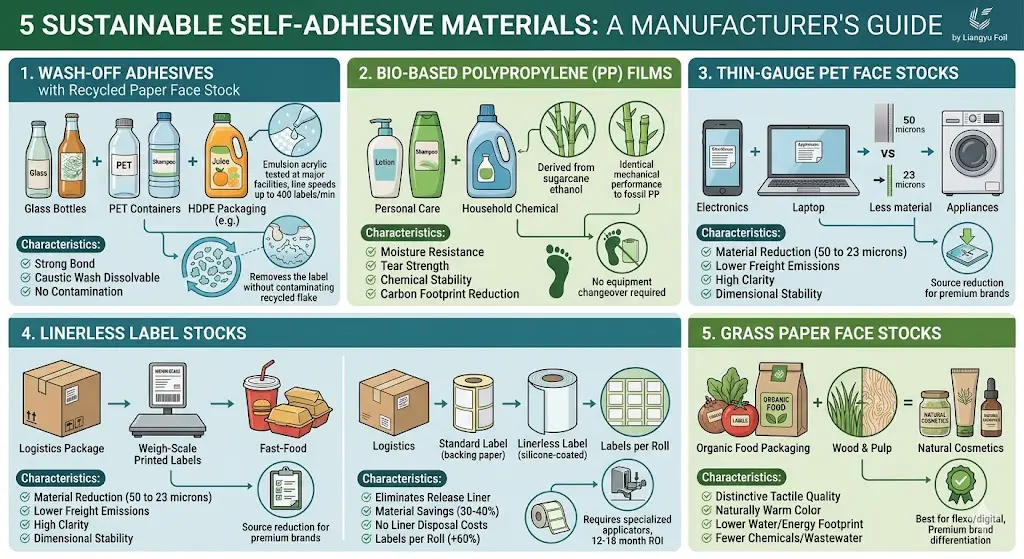
2. Bio-Based Polypropylene (PP) Films
When you need moisture resistance, tear strength, or chemical stability, paper simply will not cut it. Bio-based PP films, derived from sugarcane ethanol rather than petroleum, offer identical mechanical performance to conventional PP but with a measurable reduction in cradle-to-gate carbon footprint.
We have seen adoption accelerate significantly in personal care and household chemical segments where brands need both durability and a credible renewable story. The material prints beautifully with flexographic and digital presses, and it behaves identically to fossil-based PP on applicators, so there is no equipment changeover required.
Best for: Personal care, household chemicals, any application requiring filmic durability with a renewable claim.
3. Thin-Gauge PET Face Stocks
This is not a bio-based material, but it is a legitimate sustainability strategy through source reduction. By reducing PET gauge from the standard 50 microns down to 23 microns, you use less than half the material per label, reduce shipping weight, and maintain the optical clarity and dimensional stability that premium brands demand.
The environmental math is straightforward: less material means less embodied carbon, less freight emissions, and less end-of-life waste. We have supplied thin-gauge PET to electronics and appliance manufacturers who need the durability of film but are under pressure to reduce packaging mass.
Best for: Electronics, appliances, premium cosmetics where source reduction aligns with sustainability goals.
4. Linerless Label Stocks
Linerless is the most transformative option on this list because it eliminates the release liner entirely. The silicone-coated liner accounts for 30-40% of a standard label roll’s weight and volume, serves a single purpose, and is immediately discarded. Removing it reduces material consumption, eliminates liner disposal costs, and increases labels per roll by up to 60%.
The trade-off is equipment. Linerless requires specialized applicators with non-stick platen rollers and guillotine cutters. We have helped several logistics and food-service clients through this transition, and the ROI typically lands between twelve and eighteen months when annual volume exceeds five million labels. Our linerless labels guide covers the technical requirements in detail.
Best for: Logistics, weigh-scale printing, fast-food labeling, any high-volume continuous operation.
5. Grass Paper Face Stocks
Grass paper is made from up to 50% grass fiber combined with conventional wood pulp. It has a distinctive tactile quality, a naturally warm color, and a significantly lower water and energy footprint than pure wood-pulp paper. The production process uses less chemicals and generates less wastewater.
The challenge is printability. Grass fibers can cause linting on offset presses, so flexographic or digital printing is usually the better choice. We have supplied grass paper stocks to organic food brands and natural cosmetics companies where the tactile quality and sustainability story justify the slight premium.
Best for: Organic food, natural cosmetics, premium brands where tactile differentiation and sustainability credentials matter.
What Are 17 Sustainable? Understanding the SDG Connection
You might have seen references to “17 sustainable” in industry discussions. This refers to the United Nations Sustainable Development Goals, a framework of 17 global objectives adopted in 2015. For the self-adhesive industry, the most relevant goals are:
Goal 9: Industry, Innovation, and Infrastructure (driving cleaner production technologies)
Goal 12: Responsible Consumption and Production (reducing waste and improving recyclability)
Goal 13: Climate Action (reducing carbon footprint across the supply chain)
Goal 14: Life Below Water (eliminating liner waste that can enter marine environments)
At Jumelage, our GMP-certified production facilities align with Goal 12 by maintaining strict environmental management systems and waste reduction protocols.
What Is the Most Sustainable Material? It Depends on Your Definition
If you are looking for the single “best” sustainable self-adhesive material, the honest answer is that there is not one. The most sustainable choice depends entirely on your constraints.
| If Your Priority Is… | Choose… | Why |
|---|---|---|
| Maximum recyclability | Wash-off adhesive + recycled paper | Clean separation in standard recycling streams |
| Lowest carbon footprint | Linerless stock | Eliminates 35-40% of material mass and waste |
| Renewable content claim | Bio-based PP | Plant-derived with identical performance |
| Source reduction | Thin-gauge PET | Uses <50% material vs. standard gauge |
| Premium brand positioning | Grass paper | Unique tactile quality + low water/energy footprint |
The mistake we see most often is brands choosing a material based on marketing appeal rather than end-of-life reality. A grass paper label on a non-recyclable container is greenwashing. A wash-off adhesive on a recyclable bottle is genuine circular economy.
What Are 20 Natural Materials? The Broader Context
Beyond the five options we have covered, the broader materials world includes natural alternatives like bamboo fiber, cotton linters, hemp, cork, and agricultural waste streams. In the self-adhesive space, most of these are not yet commercially viable at industrial scale, but they are worth monitoring. We are actively testing several agricultural waste fibers in our R&D lab for future product development.
What Are the 4 Types of Sustainability?
The four types of sustainability provide a useful framework for evaluating any material claim:
Human Sustainability: Fair labor practices and safe working conditions throughout the supply chain.
Social Sustainability: Community impact and responsible sourcing.
Economic Sustainability: Long-term viability without hidden costs or externalized impacts.
Environmental Sustainability: The one most people focus on, reducing resource consumption, emissions, and waste.
A truly sustainable material needs to perform across all four dimensions. That is why we prioritize ISO 14001 environmental management and GMP certification at our manufacturing facility, not just green materials.
Which Materials Are Environmentally Friendly? The Certification Checklist
When evaluating whether a self-adhesive material is genuinely environmentally friendly, look for these third-party certifications rather than generic claims:
| Certification | What It Verifies | Look For It On… |
|---|---|---|
| FSC (Forest Stewardship Council) | Responsibly sourced paper fibers | Paper face stocks |
| OK Compost / TÜV | Biodegradability in industrial composting | Bio-based films |
| ISO 14001 | Environmental management systems | Manufacturing facilities |
| Cradle to Cradle | Circular design and material health | Premium sustainable products |
Be wary of vague “eco-friendly” badges without third-party verification. The self-adhesive industry is rife with unsubstantiated claims.
What Are 10 Materials That Can Be Recycled? The Self-Adhesive Challenge
In theory, paper, PET, PP, HDPE, glass, aluminum, steel, cardboard, and certain bioplastics are all recyclable. The challenge with self-adhesive labels is that the adhesive itself can contaminate the recycling stream. That is why wash-off adhesives are so important, they allow the label to separate cleanly from the substrate during the recycling process.
According to FINAT, the European label association, adhesive contamination is one of the top three challenges facing packaging recyclability today.
What to Ask Your Supplier Before Specifying a Sustainable Material
The self-adhesive industry is full of vague claims. Here are the questions we encourage our clients to ask:
Is the adhesive compatible with the end-of-life pathway of the labeled substrate? A recyclable label on a recyclable bottle is pointless if the adhesive contaminates the recycling stream. Demand compatibility testing data.
What certifications does the material carry? Look for FSC, OK Compost, TÜV, or Cradle to Cradle verification. Generic badges mean nothing.
What is the trade-off? Almost every sustainable alternative involves some compromise in cost, performance, or processing latitude. If a supplier claims there is no downside, they are misleading you.
Can you provide a lifecycle assessment (LCA)? A credible supplier should share cradle-to-gate carbon data. We provide this for our core product lines upon request.
Sustainable Self-adhesive Materials
Sustainability in self-adhesive labeling is not about finding a single perfect material. It is about matching the right construction to your application, your customer’s recycling infrastructure, and your brand’s regulatory environment. Sometimes that means a wash-off paper label for a beverage bottle. Sometimes it means a linerless filmic stock for a logistics operation. And sometimes it means accepting that the most sustainable choice today is simply using less material.
