
Table of Contents
In the multi-billion dollar packaging industry, efficiency and aesthetics are the two pillars of success. If you are a procurement manager or a brand owner, understanding what is a PSL label is fundamental to optimizing your supply chain. PSL, an acronym for Pressure Sensitive Label, has revolutionized how products—from pharmaceutical bottles to premium cosmetics—are identified and marketed.
At Jumelage, our 35,000㎡ GMP-certified facility operates at the intersection of French engineering precision and Chinese manufacturing scale. To fully answer “what is a PSL label”, we must look beyond the sticker surface into the complex multi-layer construction and the visco-elastic chemistry that makes this technology the global standard in 2026
This article is for general information, not medical advice. For wound closure, infection risk, and injury care, follow local clinical guidance or consult a qualified clinician.
What are PSL Labels? (The Technical Definition)
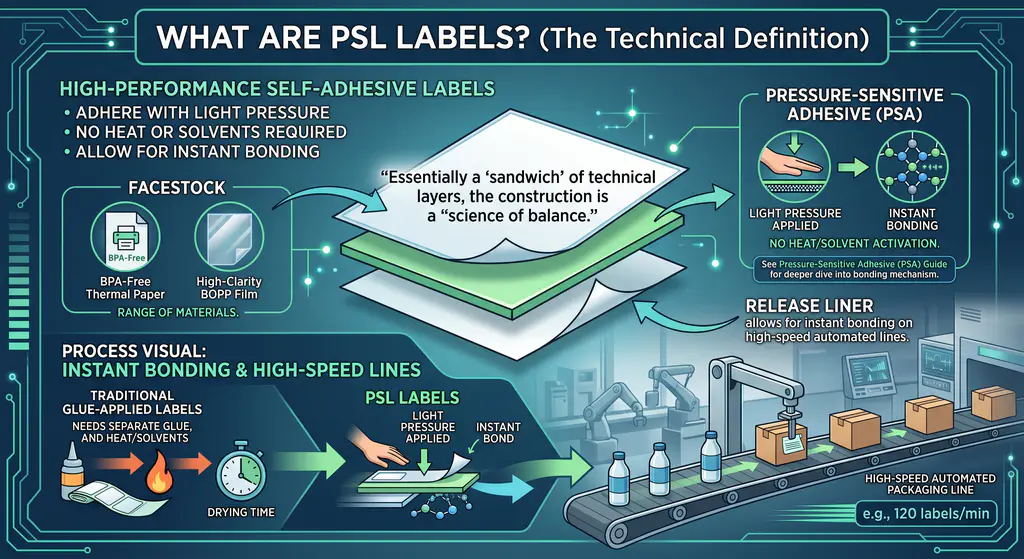
PSL labels are high-performance self-adhesive labels that adhere to surfaces through the application of light pressure. Unlike traditional glue-applied labels that require heat or solvent activation, a PSL label consists of a facestock, a pressure-sensitive adhesive (PSA), and a release liner, allowing for instant bonding on high-speed automated packaging lines.
The construction of these materials is a science of balance. When we define what is a PSL label, we are essentially describing a “sandwich” of technical layers. The facestock can range from BPA-Free Thermal Paper to high-clarity BOPP films. For a deeper dive into the bonding mechanism, see our Pressure-Sensitive Adhesive (PSA) Guide.
What is a PSL in Business?
In a business context, PSL stands for a strategic branding tool that offers superior shelf appeal and application versatility. For manufacturers, utilizing PSL labels means lower downtime on production lines, as there is no mess from liquid glues, and the ability to apply labels to virtually any substrate, including glass, plastic, and metal.
For B2B entities, the ROI of switching to PSL technology is often found in the reduction of “total applied cost.” While the material cost per unit might be slightly higher than wet-glue labels, the speed of application and reduced waste make it the superior choice. This is why understanding what is a PSL label is a prerequisite for any modern packaging audit. To compare different bonding costs, refer to our Self-Adhesive vs. Adhesive report.
What are the 4 Types of Labels?
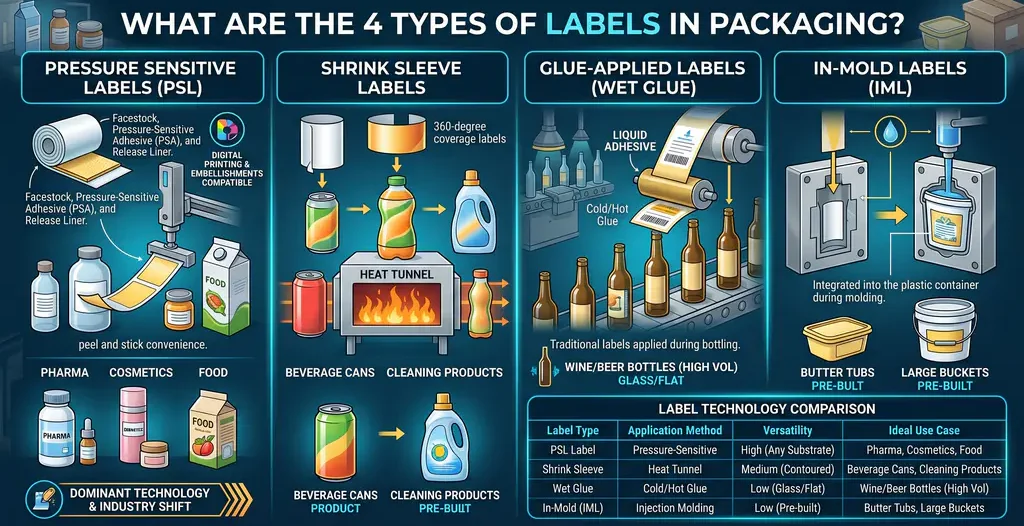
In the broader packaging world, the question “what is a PSL label” is often followed by a comparison of the four primary labeling technologies used in 2026:
- Pressure Sensitive Labels (PSL): The focus of this guide, known for “peel and stick” convenience.
- Shrink Sleeve Labels: 360-degree coverage labels that shrink to the container’s shape using heat.
- Glue-Applied Labels (Wet Glue): Traditional labels where liquid adhesive is applied during the bottling process.
- In-Mold Labels (IML): Labels that are integrated into the plastic container during the molding process.
While each has its niche, PSL labels dominate the market due to their compatibility with digital printing and embellishments. If you’re still confused about the terminology, we recommend checking out What does self-adhesive mean? to understand the core technology.
The data below outlines why the industry is shifting towards PSL technology for premium B2B applications.
| Label Type | Application Method | Versatility | Ideal Use Case |
|---|---|---|---|
| PSL Label | Pressure-Sensitive | High (Any Substrate) | Pharma, Cosmetics, Food |
| Shrink Sleeve | Heat Tunnel | Medium (Contoured) | Beverage Cans, Cleaning Products |
| Wet Glue | Cold/Hot Glue | Low (Glass/Flat) | Wine/Beer Bottles (High Vol) |
| In-Mold (IML) | Injection Molding | Low (Pre-built) | Butter Tubs, Large Buckets |
What Does PSA Mean in Manufacturing?
In manufacturing, PSA stands for Pressure Sensitive Adhesive, the functional “engine” of a PSL label. Unlike structural adhesives that cure via chemical reactions, PSA remains permanently tacky. It is engineered from acrylic or synthetic rubber polymers that form van der Waals bonds with a substrate upon contact, ensuring a secure and durable attachment.
At Jumelage, our PSA formulations are optimized for GMP-grade medical and pharmaceutical labels. When asking what is a PSL label, the quality of the PSA determines whether the label will survive extreme environments, such as cryo-storage or high-heat sterilization. We utilize FINAT testing standards to ensure our adhesives meet the strictest B2B requirements.
Is Private Labeling Illegal?
No, private labeling is completely legal and a standard practice in global commerce. It involves a manufacturer producing goods (like custom self-adhesive rolls) that are sold under another company’s brand. Legality is maintained through formal OEM/ODM contracts and compliance with regional labeling laws, such as those governed by the FDA or EU regulations.
For brands looking to scale, private labeling is the fastest route to market. By understanding what is a PSL label, a brand can work with a manufacturer like Jumelage to create proprietary facestock and adhesive combinations that differentiate their product while remaining legally compliant with international trade standards.
The mistake we see most often is brands choosing a material based on marketing appeal rather than end-of-life reality. A grass paper label on a non-recyclable container is greenwashing. A wash-off adhesive on a recyclable bottle is genuine circular economy.
5 Advanced Features of Modern PSL Labels
To truly appreciate what is a PSL label in 2026, one must consider the advanced functional coatings and material innovations:
- Tamper-Evident Tech: Labels that leave a “VOID” message or destruct upon removal, critical for security packaging.
- Extended Content Labels (ECL): Multi-layer “booklet” labels that allow for extensive regulatory information on small containers.
- Low-Migration Adhesives: Essential for food safety, ensuring no chemicals leach from the label into the product.
- Sustainable Liners: Moving from PET liners to FSC-certified paper or wash-off adhesives to improve recyclability.
- Smart Labeling: Integration of RFID and NFC chips directly into the PSL construction for real-time tracking.
Why PSL is the Future of Packaging
Answering what is a PSL label reveals a technology that is far more than just “stickers.” It is a multi-disciplinary engineering solution that combines polymer science, high-speed logistics, and brand psychology. For the B2B sector, the PSL label offers an unmatched combination of speed, durability, and visual excellence.
